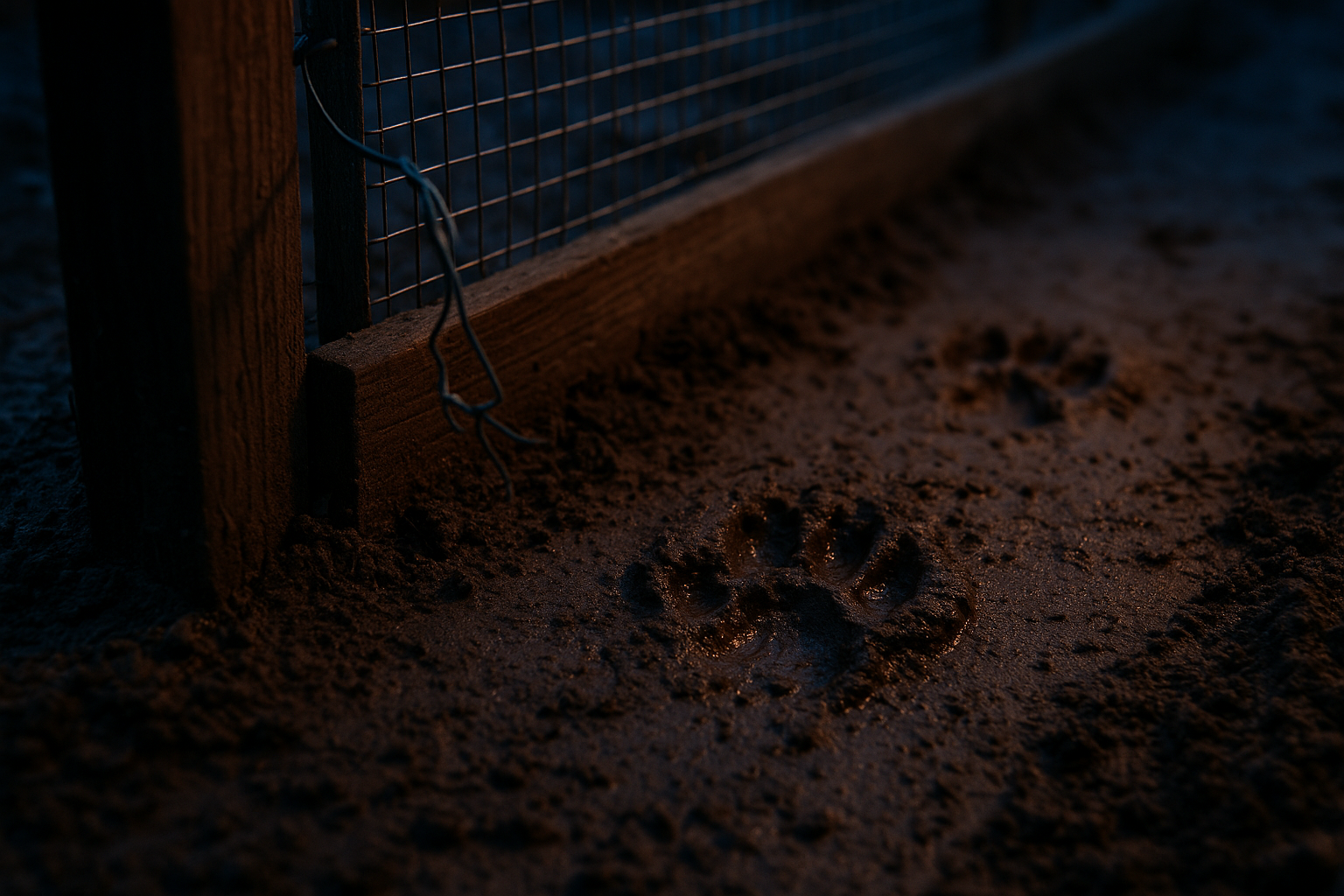
The first thing most keepers do after losing a bird is search “what killed my chickens” at 11pm. The answers you find are usually too generic to identify anything and too graphic to be worth reading. This page is built to do one job: match what you found to what did it, so you know which hole to close tonight.
This guide cuts straight to the diagnostic. Each predator leaves a distinct signature — kill style, what’s missing, time of day, entry point, tracks. If you read the evidence carefully, you can identify the predator within 20 minutes and know exactly what to fix before it comes back.
Because it will come back. Predators that score once return within 48 hours. The window between the first attack and the second is when you have to act.
Step 1: read the evidence in order
Five questions, in this order:
- What’s missing or damaged? Heads only? Whole bird? Just eggs? Bird intact with bite wounds?
- Where did the attack happen? Inside the coop, inside the run, free-range area?
- When? Daylight, dawn/dusk, full dark?
- How did the predator get in? Dug under, climbed over, tore through wire, walked through an open door?
- Any tracks, scat, or fur nearby? Check soft soil at the entry point, the perimeter, and any nearby feather piles.
Five clues. Each predator has a distinct combination. Here’s the cheat sheet.
Predator-by-predator identification
🦝 Raccoon — the most common North American chicken killer
Signature:
- Heads only missing, bodies remain in or near the coop
- Multiple birds killed in one night (surplus killing)
- Attack happens overnight, especially around midnight to 3am
- Entry: pulled chicken wire off staples, opened single-action latches, reached through fencing
- Tracks: hand-like 5-toed prints, very distinctive
- Often returns within 24-48 hours for a second pass
Why heads only: raccoon pulls the bird against the wire, grabs the head, only the head fits back through.
Fix:
- Replace any chicken wire with 1/2-inch hardware cloth
- Install two-step or padlock latches on all doors
- Lock the coop at dusk, every night, without exception
- Cover the run roof with hardware cloth or heavy netting
- Eliminate food attractants (spilled feed, trash, pet food)
🦊 Fox — clean kill, carried off
Signature:
- Whole bird missing, sometimes with a feather trail
- Quick clean attack, usually at dawn or dusk
- Entry: dug under the fence (look for 6-12 inch hole), or jumped/climbed a low fence
- Tracks: 4-toed canine prints, narrower than dog tracks, claws visible
- Feather pile 100-300 feet away if you can find it
Why carried off: foxes are smaller than coyotes and prefer to carry prey back to a den or safe pluck site.
Fix:
- 24-inch hardware-cloth predator apron buried just under the soil around the perimeter
- 6-foot fence height minimum
- Lock the coop at dusk
- Eliminate brushy hiding cover within 30 feet of the coop
🐺 Coyote — bigger version of fox
Signature:
- Whole bird missing, often multiple birds
- Attack any time of day, but most common dawn/dusk
- Entry: dug under, jumped over (coyotes clear 6-foot fences from a standing start)
- Tracks: larger canine prints than fox, similar shape
- Often paired with neighbors reporting coyote sightings or hearing yips at night
- Frequently kills in pairs or family groups
Fix:
- Predator apron + 6-foot fence with hot wire or electric strand on top
- Solid-walled coop (not just hardware cloth) for overnight roosting
- Lock the coop at dusk
- Consider a livestock guardian dog (LGD) if you have the space and budget
🐱 Domestic dog — neighbor’s dog or feral
Signature:
- Multiple birds killed but often not eaten — torn, scattered, dropped
- Attack during the day usually
- Entry: jumped or pushed through fencing, sometimes dug under
- Tracks: rounder than fox/coyote, claws often blunted
- Bodies left torn but mostly in place
Why not eaten: dogs kill from prey drive, not hunger. They’re playing.
Fix:
- Identify the dog and talk to the owner (most state laws hold dog owners liable)
- 6-foot fence with no climbable structure adjacent
- Document with photos and dated logs — needed if you escalate to animal control
- If feral, contact county animal control
🦫 Opossum (possum) — opportunistic egg + chick predator
Signature:
- Eggs missing, sometimes broken with edges chewed
- Young chicks taken, adult birds rarely
- Adult bird attacks: chest and abdomen torn open, intestines eaten, rest left
- Slow-moving, nocturnal
- Tracks: distinctive 5-toed with opposable thumb on hind feet (looks like little hands)
- Often caught at the scene in the morning if they overslept
Fix:
- 1/2-inch hardware cloth on every opening including the egg-collection door
- Predator apron — opossums dig poorly but can crawl through small gaps
- Remove pet food, bird seed, and trash that attract them
🦨 Skunk — egg specialist
Signature:
- Eggs missing, often with neat-edged holes in the shell
- Small holes dug under the fence (5-7 inches diameter)
- Spray smell sometimes lingering at the entry point
- Young chicks occasionally taken
- Adult chickens almost never attacked (size mismatch)
Fix:
- Hardware-cloth apron + nest-box inspection
- Don’t trap unless you can release safely — skunks spray when trapped
🦡 Mink and weasel — kill many, eat little
Signature:
- Multiple birds dead inside the coop, blood on necks
- Very small entry holes (1-2 inches) — weasels squeeze through anything bigger than a quarter
- Often no obvious dig or climb — they find the gap you missed
- Surplus killing like raccoons but bloodier
- Northern US and Canada most common
Fix:
- Audit every gap in the coop with a flashlight at night
- 1/2-inch hardware cloth is the maximum — weasels go through 1-inch
- Seal any opening bigger than your thumb
🐍 Snake — eggs and chicks
Signature:
- Eggs missing with no shell remains (snake swallowed whole)
- Chicks disappear without trace
- Snake found curled in a nesting box
- Rat snake, king snake, gopher snake, bull snake most common in US
- No tracks (they leave a smooth belly drag in soft dirt sometimes)
Fix:
- 1/2-inch hardware cloth on every opening
- Daily egg collection (don’t let eggs sit overnight)
- Eliminate rodent populations that attract snakes
- Most chicken-coop snakes are non-venomous — relocate when possible
🦅 Hawk — daytime aerial attack
Signature:
- Single bird, attack during daylight
- Bird often dead in the run with feather pile circling the body
- Cooper’s hawks attack from cover; red-tails dive from height
- Sometimes only feathers remain if the hawk carried off a chick or small hen
- Hens often hide in shrubs for hours after a hawk strike
Fix:
- Run-top netting or hardware cloth — even 2-inch garden netting deters most hawks
- Provide visual cover (shrubs, lean-tos) in the run so birds have refuge
- A rooster genuinely helps — they scan the sky and warn the flock
- Reflective tape strung overhead can disrupt hawk targeting
🦉 Owl — nighttime aerial attack
Signature:
- Bird missing entirely from an unsecured roost
- Sometimes a headless bird left behind (owl can carry the head but not the body)
- Attack overnight
- Great horned owl is the main culprit in most of US
- Sometimes pellets (regurgitated bone + fur) found nearby
Fix:
- Cover any open-roof roosting area
- Make sure birds are in a fully-enclosed coop at dusk
- Reflective objects don’t help (owls hunt by sound)
🐀 Rat — egg + chick predator + disease vector
Signature:
- Eggs disappearing or partially eaten
- Chicks disappearing
- Adult bird toes sometimes chewed at night (rats nibble exposed feet)
- Tunnels under the coop or run
- Visible burrow holes 2-3 inches in diameter
- Rat droppings in the feed area
Fix:
- Store feed in metal bins with locking lids
- Daily egg collection
- Eliminate spilled feed
- Hardware cloth on coop floor if rats have established
- Trap with snap traps; avoid poison around chickens
🐈 Bobcat (and lynx in northern regions)
Signature:
- Whole bird missing, often dragged off
- Single-bird attack typically
- Tracks: large rounded cat prints, no claw marks (claws retracted)
- Attack any time of day but most common dawn/dusk
- More common in rural and semi-rural settings
Fix:
- Same as coyote — 6-foot fence + apron + secure overnight coop
- Bobcats climb well — covered run if you’re in bobcat country
Quick-reference identification table
| Evidence | Most likely predator |
|---|---|
| Heads only, bodies remain, overnight | Raccoon |
| Whole bird missing, dug under fence | Fox or coyote |
| Multiple birds killed, not eaten, daytime | Dog |
| Eggs gone, no shell | Snake |
| Eggs broken with edges chewed | Opossum or skunk |
| Small entry hole (under 2”), multiple kills | Weasel or mink |
| Bird dead in run, feather pile, daylight | Hawk |
| Bird missing from open roost, overnight | Owl |
| Chicks disappearing, eggs partial | Rat |
| Whole bird carried off, large cat tracks | Bobcat |
The universal fix list (do these regardless of which predator hit you)
Even before you’ve identified the specific predator, these moves stop 90% of attacks:
- Replace any chicken wire with 1/2-inch galvanized hardware cloth. Chicken wire is the single most common failure point.
- Install a 24-inch hardware-cloth predator apron flat on the ground around the run perimeter, soil-covered. Defeats diggers without trenching.
- Lock the coop at dusk every night with a two-step latch. Never skip a night.
- Hardware-cloth the run roof, not just the sides. Defeats aerial predators and climbing raccoons.
- Audit every gap with a flashlight at night — weasels enter through anything bigger than a quarter.
- Eliminate food attractants within 30 feet of the coop (spilled feed, pet food, unsecured trash, fallen fruit).
- Daily egg collection to defeat snakes, rats, and opossums.
- Trim vegetation within 10 feet of the coop — predators hate crossing open ground.
Our predator-proof coop guide has full hardware specs and apron build instructions.
What to do RIGHT NOW if you just lost a bird
- Photograph the scene before disturbing anything. Wide shot + close-ups of entry points + tracks.
- Don’t bury the bodies yet — predators often return for them within 24 hours. You can set up to confirm the predator type by watching at dusk or using a wildlife camera.
- Move surviving birds to the most secure space available for the next 72 hours — typically inside the coop with the run closed.
- Run the universal fix list above before nightfall today.
- Set a wildlife camera at the entry point if you have one. Confirming the predator type helps you target the fix.
- Talk to neighbors. They often have lost birds to the same predator and have context (dog owner, fox den location, etc.).
What NOT to do
- Don’t shoot every predator you see. Most are protected by state law (hawks, owls, sometimes foxes). Check state regulations before any lethal removal.
- Don’t use poison anywhere chickens can reach. Birds will find it.
- Don’t rely on dogs alone. Family dogs that hate raccoons during daylight are often asleep at 3am when raccoons attack.
- Don’t assume it was “just a bad luck night.” Predator attacks are pattern behavior. Without a fix, the second attack is coming.
Next steps
- Predator-Proof Coop Guide — hardware specs and the apron build
- Coop Materials List — exactly which hardware cloth and latches to buy
- Heated Chicken Coop Guide — winter management so birds don’t huddle in unsecured spots
- How to Build a Chicken Coop — full secure-build process
- Expensive Coop Mistakes — the chicken-wire mistake leads the list
Related Plans
Runs are where predator-proofing matters most, since chickens spend the day in them unsupervised — the 10x20 standalone chicken run and the 8x16 standalone chicken run are both built to the same buried-apron, hardware-cloth standard described above. Ducks are just as vulnerable at night as chickens are, and the 4x6 duck house and 6x8 duck house plans use the same two-action latches and 1/4-inch mesh throughout.