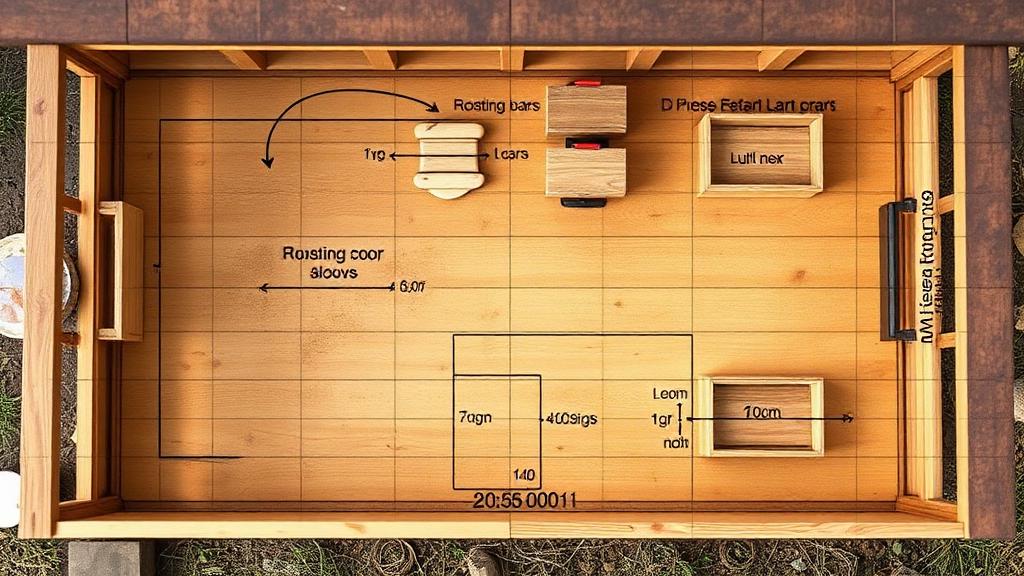
Standard breeds need 4 sq ft of coop floor space and 8–10 sq ft of run per bird. Bantams need 2 sq ft of coop space. Heavy breeds like Brahmas and Jersey Giants need 5 sq ft. Those three numbers answer 90% of the sizing questions I hear from new keepers.
The rest of this guide shows you the math, gives you a full table by flock size, and explains what goes wrong when a coop is too small — because that part gets skipped in most beginner resources.
Once the calculator gives you a square-footage target, match it to one of the free chicken coop plans — the line runs from compact 2–3 hen tractors up to a walk-in coop for 14–18 hens, so one of them will land on your number without any redesign.
Raising chicks first? Space works completely differently for them — run the numbers through the chicken brooder size calculator, which sizes by chick age from day-old through week eight.
How Much Space Does a Chicken Need in a Coop?
The universally cited minimum is 4 square feet of coop floor per standard hen. That figure comes from university extension programs and lines up with what I’ve seen work in practice across a lot of backyard setups.
It applies to the floor — not wall space, not air volume. It also assumes the birds have access to an outdoor run. If they’re confined to the coop full-time (no run at all), you need to roughly double it.
Here’s how space requirements break down by bird type:
- Bantam breeds (Silkies, Seramas, Japanese): 2 sq ft coop, 5 sq ft run
- Standard breeds (Rhode Island Reds, Australorps, Plymouth Rocks): 4 sq ft coop, 10 sq ft run
- Heavy/large breeds (Brahmas, Jersey Giants, Cochins): 5 sq ft coop, 10–15 sq ft run
How Many Square Feet Per Chicken? The Math
The formula is simple:
Coop floor area = number of hens x sq ft per bird
Run area = number of hens x 10
Worked example for 6 standard hens:
- Coop floor: 6 x 4 = 24 sq ft (a 4x6 or roughly 5x5 footprint)
- Run: 6 x 10 = 60 sq ft (a 6x10 or 8x8 works)
- Nesting boxes: 6 hens / 3 = 2 boxes
- Roost bar: 6 x 10 inches = 60 linear inches (5 feet of roost)
That’s all there is to it. No multipliers needed for a basic backyard flock with normal run access.
Quick Reference: Coop Size by Flock Count
Use this table to size your coop before you build. “Recommended Dimensions” are the most practical footprints that hit the minimum square footage without weird cuts.
| Hens | Min Coop Floor (sq ft) | Recommended Dimensions | Min Run (sq ft) | Nesting Boxes |
|---|---|---|---|---|
| 2 | 8 | 2x4 or 4x2 | 20 | 1 |
| 3 | 12 | 3x4 | 30 | 1 |
| 4 | 16 | 4x4 | 40 | 1–2 |
| 6 | 24 | 4x6 | 60 | 2 |
| 8 | 32 | 4x8 | 80 | 2–3 |
| 10 | 40 | 5x8 | 100 | 3 |
| 12 | 48 | 6x8 | 120 | 3–4 |
| 15 | 60 | 6x10 | 150 | 4–5 |
| 20 | 80 | 8x10 | 200 | 5–7 |
Our standing recommendation: build one size up from your current flock. Flocks grow, and expanding a finished coop is almost always a teardown rather than an addition.
For smaller flocks, the small chicken coop plans section covers pre-designed footprints that already hit these minimums. For larger setups, see large chicken coop plans.
Plans Sized for Your Flock
Once you have a number, match it to a design. Every plan below is sized by the same math on this page, and the capacity is the design’s own maximum, not a stretch. Material costs are the ranges from each plan’s own bill of materials.
| Your flock | Plan | Coop floor | Run | Materials |
|---|---|---|---|---|
| 2–3 hens | 4x4 starter coop | 10 sq ft | 16 sq ft | $1,650–$2,150 |
| 3–5 hens | 6x8 A-frame coop | 15 sq ft | 26 sq ft | $975–$1,275 |
| 3–4 hens | 4x6 coop with run | 16 sq ft | 24 sq ft | $1,900–$2,450 |
| 4–6 hens | 4x8 shed coop | 23 sq ft | 32 sq ft | $2,250–$2,900 |
| 4–6 hens | 4x8 lean-to coop | 23 sq ft | 32 sq ft | $2,100–$2,750 |
| 6–9 hens | 6x8 coop with run | 37 sq ft | 48 sq ft | $2,700–$3,450 |
| 7–10 hens | 6x8 walk-in shed coop | 37 sq ft | 60 sq ft | $2,900–$3,750 |
| 7–10 hens | 6x8 pallet-clad coop | 37 sq ft | 60 sq ft | $2,850–$3,800 |
| 7–10 hens | 6x8 modern coop | 37 sq ft | 60 sq ft | $3,600–$4,700 |
| 9–12 hens | 6x10 walk-in shed coop | 47 sq ft | 72 sq ft | $3,200–$4,100 |
| 10–13 hens | 8x8 walk-in shed coop | 51 sq ft | 80 sq ft | $3,200–$4,100 |
| 12–14 hens | 8x10 walk-in shed coop | 66 sq ft | 96 sq ft | $3,700–$4,750 |
| 14–18 hens | 8x12 walk-in with feed room | 58 sq ft | 128 sq ft | $4,250–$5,450 |
| 15–17 hens | 10x10 walk-in shed coop | 84 sq ft | 120 sq ft | $4,150–$5,350 |
| 12–19 hens | 8x12 coop with run | 80 sq ft | 96 sq ft | $3,950–$5,050 |
| 18–22 hens | 10x12 walk-in with feed room | 74 sq ft | 160 sq ft | $4,700–$6,000 |
| 19–26 hens | 8x16 walk-in with feed room | 79 sq ft | 160 sq ft | $4,950–$6,400 |
A few things the table hides. The walk-ins with a feed room give up coop floor to store feed and bedding, which is why the 8x12 walk-in has less bird floor (58 sq ft) than the smaller 8x10 (66 sq ft). For a flock of 20, the 10x12 and 8x16 are the two designs that clear it without leaning on a bigger run. And if your hens need nesting space more than floor space, a 3-box nest bank gives nesting for up to 12 layers as its own small build.
How Big of a Coop for 4 Chickens?
A 4x4 coop (16 sq ft) is the standard answer for 4 standard-breed hens. It works, but it’s snug. If you can swing a 4x6 (24 sq ft), your flock will be noticeably calmer and cleaner because there’s room to establish pecking order without constant conflict.
For 4 birds, pair a 4x4 coop with at least a 4x10 run (40 sq ft). The 4x4 coop plans page has full material lists and structural drawings for this exact size.
How big of a coop for 6 chickens? You need at least 24 sq ft — a 4x6 footprint. For 8 chickens, go 4x8 (32 sq ft). For 10 chickens, 5x8 (40 sq ft). For 12 chickens, 6x8 (48 sq ft). For 20 chickens, 8x10 (80 sq ft) — or two separate coops, which I actually prefer at that scale for disease management.
Coop Size by Breed Type
Breed matters more than most beginners realize. A flock of 6 Silkies fits in the same coop as 3 Brahmas. If you’re mixing breed sizes, size for the largest birds in your flock.
| Breed Type | Example Breeds | Coop (sq ft/bird) | Run (sq ft/bird) | Roost (inches/bird) | Notes |
|---|---|---|---|---|---|
| Bantam | Silkie, Serama, Japanese | 2 | 5 | 6–8 | Good for tight urban lots |
| Standard | RIR, Australorp, Leghorn | 4 | 10 | 8–10 | The baseline for most flocks |
| Heavy/Large | Brahma, Jersey Giant, Cochin | 5 | 10–15 | 10–14 | Need taller pop doors and lower roosts |
Stick to one size category for your first flock. Mixing bantams and heavies creates management headaches — bantams get bullied off the roost and out of feeders.
Run Size Requirements
The run is where your birds spend most of their waking hours. Under-sized runs cause the same problems as under-sized coops: feather-picking, stress, and disease.
Minimum: 10 sq ft per standard bird in the run. That’s the floor. If you’re in a climate where the birds stay in the run all day rather than ranging freely, I’d push toward 15 sq ft per bird.
If your birds free-range in a yard for 6+ hours a day, you can get by with a smaller holding run (6–8 sq ft per bird) because the run is just a staging area, not their primary living space.
Good run design makes a measurable difference in flock behavior. The chicken run design guide covers hardware cloth gauges, predator aprons, and roofing options that affect how much usable space your birds actually get.
Nesting Box and Roost Bar Sizing
Nesting Boxes
The rule: one nesting box per 3–4 hens. Hens share willingly — you don’t need a box per bird, and a surplus of boxes wastes wall space.
Proper box dimensions:
- Standard breeds: 12 x 12 x 12 inches minimum
- Heavy breeds: 14 x 14 x 14 inches
- Mount at least 18 inches off the floor but lower than the roost bars
If boxes are higher than roosts, hens sleep in the boxes and foul the nesting material nightly. Keep the roost higher. The nesting box guide covers mounting height, materials, and how to break hens of sleeping in boxes.
Roost Bars
Allow 8–12 linear inches of roost bar per standard bird. Heavy breeds need the full 12 inches because of their width. Bantams can share more tightly at 6–8 inches each.
Roost height: 18–24 inches off the floor for standard birds. Heavy breeds and meat birds do better at 12–18 inches — they’re less agile and can injure legs jumping off high roosts.
Round off any roost edges. Flat 2x4 boards on the wide face (4 inches) work better than round dowels — chickens can lay their toes flat and keep their feet warmer in winter.
Confinement and Climate Adjustment
This is the section most guides skip, and it’s where a lot of flocks run into trouble.
The 4 sq ft per bird standard assumes birds have outdoor access most of the day. When they don’t — whether because of weather, predator pressure, or urban lot constraints — the coop has to carry more of the load.
Add 50% to your coop square footage if:
- You’re in a heavy-snow region where birds are cooped for weeks at a time
- You’re in a monsoon or heavy-rain climate (Phoenix monsoon season, Gulf Coast summers)
- Your run has no roof and the birds refuse to use it when it’s wet
- You keep a confined-only setup with no run at all
Example: 6 standard hens in a northern climate that gets 3 weeks of consecutive snow. Standard minimum = 24 sq ft. With the 50% confinement adjustment, size for 36 sq ft (a 6x6).
I’m in Phoenix. My birds are outside almost every day of the year, so I run closer to the minimums. But during two weeks of monsoon thunderstorms each July, when they won’t go outside, I see stress behaviors in coops that were sized right for fair-weather conditions. Extra floor space is cheap insurance.
What Happens When a Coop Is Too Small
Overcrowding produces a predictable sequence of problems. If you’re seeing any of these, your first check should be square footage.
Early signs (weeks 1–2 of overcrowding):
- Feather-pecking, especially tail feathers and backs
- Lower-ranking birds pushed off the roost at night
- Hens piling up in nesting boxes rather than roosting
Mid-stage signs (weeks 3–6):
- Egg production drops — stressed hens lay less
- More frequent respiratory infections from ammonia buildup
- One or more birds losing significant feather coverage
Late-stage signs:
- Vent-pecking (serious welfare issue that can be fatal)
- Cannibalism in extreme cases
- Chronic illness cycling through the flock
I consulted on a setup with 8 hens in a coop that measured 20 sq ft — 2.5 sq ft per bird. The owner thought the behavior problems were breed-related. We moved them to a 4x8 (32 sq ft) with a proper run, and the feather-pecking stopped within 10 days. Space was the entire problem.
If you’re starting from scratch, how to build a chicken coop walks through the full build process including framing for the floor area covered here.
Bottom Line
Size your coop by multiplying your flock count by 4 for indoor floor space and by 10 for run space. Add 50% to the coop number if your birds are confined for extended stretches. Build one size up from your current flock — you will add birds.
For 4 hens: 4x4 coop minimum, 4x10 run. For 6 hens: 4x6 coop, 6x10 run. For 8–10 hens: 4x8 or 5x8 coop, proportional run. Don’t go smaller than those numbers and expect a calm, productive flock.
What if they’re not chickens?
Ducks change the arithmetic. They need more floor space per bird than a hen, they don’t roost, and they carry water everywhere they go — so bedding gets wet fast and the floor has to drain or be easy to strip. Nest boxes sit on the floor rather than up a wall.
If that’s your flock, start from a design drawn for it: the 4x6 duck house suits a small group, and the 6x8 duck house gives you room to grow. Sizing a chicken coop and hoping it works for ducks is how you end up rebuilding.
The math is simple. The hard part is committing to the right size before you build, not after you’ve already got a coop full of unhappy birds.