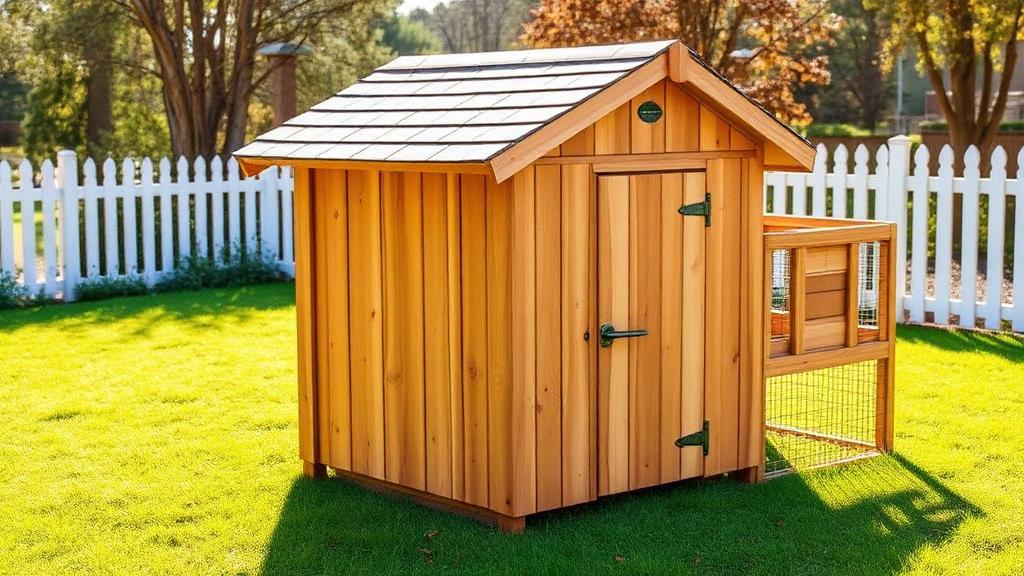
A 4x4 coop is 16 square feet on the outside, and that is not the same as 16 square feet of chicken floor. Frame the walls, raise the floor and hang a nest bank, and you’re left with about 10 square feet. That’s a real coop for two or three standard hens, and a tight one for four.
This guide covers what actually fits, what the build costs when you price every part, and the order to build it in. It also covers the four-hen question specifically, because four is the number most people land on.
Our 4x4 starter coop plan is drawn to this exact design. The free preview PDF and the full spec table on the plan page cost nothing. The complete 40-page book with every cut length is $4.99 on Etsy. Browse the whole line of chicken coop plans if you want to compare sizes first.
How Many Chickens Fit in a 4x4 Coop?
The working number is 4 square feet of coop floor per standard hen. That comes from Oregon State Extension EC 1644. Virginia Tech and eXtension agree, all three putting birds with an attached run at 3-4 sq ft each.
The catch is which 16 square feet you’re counting. A 4x4 coop measures 48 inches outside to outside. Subtract the wall framing and you’re at roughly 14 sq ft, and an interior nest bank takes another 2 to 3.
What a 4x4 Actually Holds
| Setup | Usable floor | Honest capacity |
|---|---|---|
| 4x4 shell, on paper | 16 sq ft | 4 hens |
| Our 4x4 starter plan, as built | 10 sq ft | 2-3 hens |
| 4x4 with an exterior nest bank | 13-14 sq ft | 3 hens |
| 4x4 with no run, birds confined | 10 sq ft | 1 hen |
That last row is the one people get backwards. Space requirements go up when the run goes away. Oregon State puts confined birds with no outdoor access at 8-10 sq ft each, roughly double the figure for birds that get outside.
Run the numbers for your own flock with the chicken coop size calculator before you cut anything.
Outdoor Space Is Not Optional
Penn State and Virginia Tech both put standard-breed run space at 8-10 sq ft per bird. Four hens need at least 32 square feet outside. The screened bay under a raised coop counts toward that, which is one reason our plans raise the floor.
Already have a coop and need more outdoor room? The 6x8 standalone run adds 48 sq ft of covered, apron-protected space for $850-$1,100 in materials.
What the 4x4 Starter Plan Publishes
Every number below is computed by the plan generator from the same geometry that draws the drawings. They can’t drift apart, because the cut list and the diagrams come out of one model.
| Spec | 4x4 starter coop |
|---|---|
| Coop footprint | 48” x 48” |
| Bird-usable floor | 10 sq ft |
| Attached run | 16 sq ft, under and beside the raised floor |
| Capacity | 2-3 hens |
| Floor clearance | 18” off grade |
| Nest boxes | 2 |
| Roost bar | 30 linear inches |
| Vent area | 1.5 sq ft against 10 sq ft of floor |
| Materials | $1,650-$2,150 at 2026 prices |
| Build time | One weekend, 10-14 hours |
The run on that plan is 16 sq ft. At the 8 sq ft per bird floor that covers two hens, so a third bird needs more ground than the plan ships with. Bolt on a 6x8 run or free-range daily.
Three things back those numbers up. The framing is drawn to published AWC and IRC span tables, with headers sized by the span they carry. The generator runs 2,600+ deterministic checks and refuses to export a plan that fails any of them. And every plan publishes its vent area against its floor area, so you can check the ratio yourself.
On ventilation: our design default is 1 square foot of permanent vent per 10 square feet of floor. That’s our own rule, not a published standard. What the authorities actually specify is an outcome, not a ratio. Certified Humane puts ammonia at bird height at 10 ppm or below. Ammonia damages respiratory tissue from 5 ppm, well under the 20 ppm where you’d smell it.
Building for Four Hens
Four is the number most backyard keepers settle on. It’s enough eggs to matter — roughly 20 to 24 a week in peak season — and small enough that most city ordinances don’t blink.
A 4x4 will hold four hens if they’re out in the run every day and you keep the nest bank on the outside wall. If they’re indoors for weeks at a stretch in winter, it won’t. Build one size up and the problem disappears.
Five Ways to House Four Hens
1. The 4x4 raised starter — $1,650-$2,150. Reach-in access, 18 inches off grade, run underneath. It’s the smallest build in the line and the most forgiving: every cut is square and there’s no compound miter anywhere. See the 4x4 starter coop plan.
2. The 4x6 step-up — $1,900-$2,450. Sixteen square feet of usable floor, 40 inches of roost, a 4x6 attached run. This is the honest four-hen size and it’s what we’d build if the yard allows it. See the 4x6 coop plan.
3. The 4x8 shed coop — $2,250-$2,900. Twenty-three square feet, 60 inches of roost, 4-6 hens. Buy this one if you suspect you’ll add birds, because expanding a finished coop is almost always a teardown. See the 4x8 shed coop plan.
4. The 4x8 lean-to — $2,100-$2,750. Same capacity as the shed coop, single-slope roof, designed to sit against a fence or garage wall. Cheaper and lower-profile. See the 4x8 lean-to coop plan.
5. The A-frame tractor — $675-$875. Bottomless and mobile, so the birds get fresh ground every day. Capacity is 2-3 hens and it’s the cheapest way into the hobby. See the 4x8 A-frame chicken tractor plan, or the 6x10 version for 4-6 birds.
Already have a shed? Converting one is faster than building. You skip the foundation, the framing and the roof, and you spend your time on the pop door, the vents and the nest bank. The 3-box nesting bank plan drops into a conversion for $240-$330 and covers up to 12 hens.
What Drives the Cost
The $1,650-$2,150 figure is the plan’s own bill of materials at 2026 retail, with no waste allowance and nothing left off. Here’s where it goes.
- 1/4-inch hardware cloth, 19 gauge — 52 feet of it, plus 208 fender washers. This is the single biggest line and the one every cheap coop budget omits.
- Framing and sheet goods — 39 2x4s, four 2x6s, six 4x4 posts, five sheets of 3/4-inch plywood.
- Skin and roof — lap siding, three corrugated panels, drip edge, 120 roofing screws.
- Site work — eight pier blocks, gravel under each, a cubic yard of drain rock for the run floor.
- Finish — a window, hinges, latches, caulk, primer and paint.
You can build it for less. Clad it in free pallet board instead of lap siding, skip the drain rock, and use salvaged roofing. Our 6x8 pallet coop is framed in real lumber and clad in free board on purpose. It holds 7-10 hens for $2,850-$3,800, less than a smaller coop in bought siding.
What we won’t do is publish a round $300 number. See the full cost breakdown and the materials guide for line-by-line pricing.
Build Order
Build order matters more than build skill. Do these out of sequence and you end up undoing finished work to reach something you skipped.
1. Foundation
Level the ground and set eight pier blocks on compacted gravel. Check the diagonals — if they match, the frame is square. Galvanized or stainless post anchors go at every post-to-footing connection.
2. Floor Frame
Floor joists are 2x6 at 16 inches on centre, never 2x4. No prescriptive span table published anywhere lists a 2x4 floor joist, so a 2x4 floor can’t be justified against a table at any span. The 4x4’s clear span is 42 inches, well inside the 8’-4” that a 2x6 covers in the weakest tabulated species.
3. Walls
Frame each wall flat on the ground, then stand it and brace it. Every opening gets a full assembly: king stud, jack stud, rough opening, jack stud, king stud, with a doubled header over it. No common stud may land inside a rough opening.
Run the bottom plate continuous through the door opening and saw it out after the wall is up. It’s what keeps the wall square while you move it.
4. Roof
Cut the rafters, then tie every opposing pair with a 2x4 at top-plate level. IRC R802.3 requires it — untied rafters push the walls outward progressively, and that’s a structural failure, not a cosmetic sag. The tie doubles as framing to hang a droppings board from.
5. Vents
Cut vent openings above roost height so moisture leaves without blowing across the birds. Ventilation is air exchange at or above head height. Draft is air movement at bird level. You want all of the first and none of the second.
6. Roosts and Nest Boxes
Give each bird 10 inches of roost bar, on a rounded or flattened bearing surface 1 to 2 inches across. Set bars 18-24 inches off the floor, 10-12 inches apart, at least 8 inches off the wall, staggered rather than stacked.
Nest boxes are 12 x 12 x 12 inches, one box per 4-5 hens, about 24 inches off the floor. Never site a box directly under a roost — birds on the bar foul the box below. Details in the nesting box guide.
The popular advice to lay a 2x4 flat “so feathers cover their toes and prevent frostbite” has no source behind it. Frostbite is a moisture problem, which makes ventilation the lever, not bar shape.
7. Hardware Cloth
Cover every opening with 1/4-inch hardware cloth, fastened with screws and fender washers rather than staples alone. Bury a 12-inch apron down and out around the run perimeter — Kentucky, Maryland and UF/IFAS extension all land on 12 inches as the floor.
Predator-Proofing a Small Coop
Small flocks lose birds the same way big ones do. Four things carry most of the protection.
Use 1/4-inch mesh, not chicken wire and not 1/2-inch. University of Kentucky Extension ID-245 puts a least weasel through a 1/4-inch gap. Half-inch mesh genuinely stops raccoons, but it does not stop weasels, mink or snakes.
Understand why chicken wire fails. Kentucky ID-245 documents the mechanism. A raccoon that can’t get in reaches through the wire and takes what it can, generally the heads of the birds. The gap only has to admit a paw. Aperture size is the binding constraint, not perimeter integrity.
Fit two-action latches. We recommend them as sensible precaution. The widely repeated claim about raccoon thumb mechanics appears in no extension or wildlife-agency source, so treat it as folklore and fit the latch anyway.
Close the coop at dusk, every night. Forgetting is the single most-cited cause of predator loss. An automatic pop door at $100-$200 removes the human-error mode entirely, which is why it’s worth more than any other upgrade at this size.
More detail in the predator-proof coop guide and the predator identification guide.
Mistakes That Cost Money
- Building for today’s flock. The most repeated regret in owner reviews is building too small. If you’re weighing 4x4 against 4x6, build the 4x6.
- Chicken wire instead of hardware cloth. The most common single defect, and the most expensive to fix after the fact.
- Skipping ventilation to keep birds warm. Ammonia and condensation do more damage than cold air. Insulation without ventilation makes moisture worse, not better.
- Siting the coop in afternoon sun. Above 95°F ambient a bird can’t shed heat by convection at all, and panting becomes the only mechanism left.
- Cheap hinges and latches. Hardware is the smallest line on the bill of materials and the one that fails first.
- No real cleanout access. A coop you have to crawl into doesn’t get cleaned. Plan the access before you frame the walls.
- Forgetting the run. The coop is where they sleep; the run is where they live. See the chicken run design guide.
The expensive coop mistakes guide covers the rest.
Where to Go From a 4x4
Most keepers add birds within two years. Plan the exit before you build the entrance.
Add a run. The cheapest expansion. A 6x8 standalone run bolts on for $850-$1,100 and buys you outdoor space for up to nine birds.
Add a second small coop. Useful for quarantine, brooding or keeping a broody hen separated. A 4x6 alongside the 4x4 shares your feed and water setup.
Move up to walk-in. Past roughly six birds, reach-in cleaning stops being reasonable. The 6x8 coop holds 6-9 hens with 90 inches of roost, and the walk-in coop plans guide covers the sizes above that.
Working with a small yard rather than a small flock? The small backyard coop plans guide covers placement, setbacks and vertical designs for lots under a quarter acre.