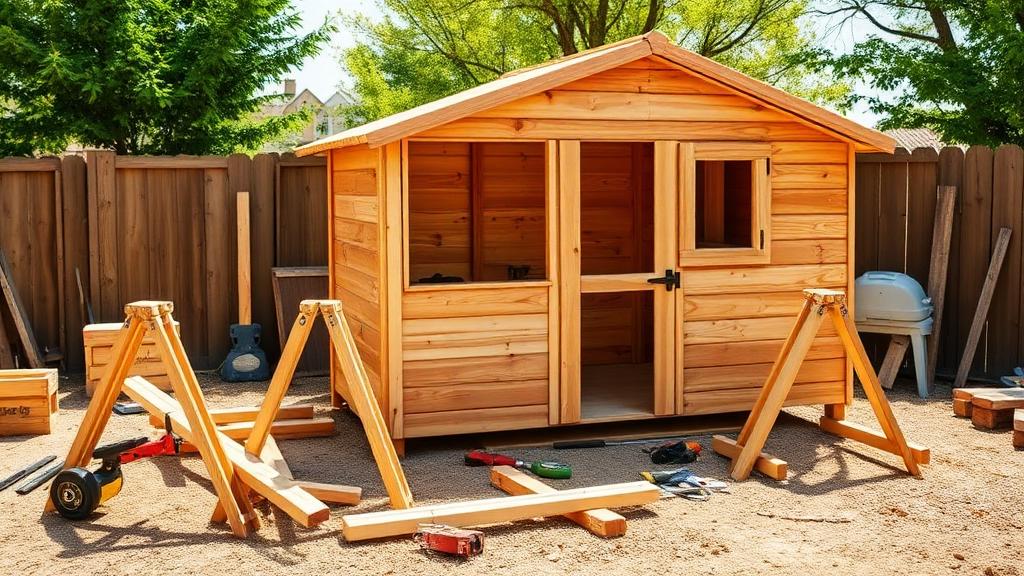
Building your first chicken coop is the moment most backyard-chicken plans either come together or quietly die. Most people stall here. They watched a YouTube video, sketched something on graph paper, then ran into the lumber aisle and froze.
This guide is the opposite of that. It’s a real step-by-step plan I’ve used and refined across four coops (and helped neighbors build 50+ more). You can finish a basic coop in a long weekend, or stretch it across 10 evenings if you only have an hour or two after work.
I built my first coop in Phoenix in 2012 and got everything wrong. My first attempt collapsed in monsoon season. A raccoon got through the chicken wire I’d been told would be “fine.” Lost three hens in one night. I spent another $800 rebuilding to fix mistakes I could have avoided in 20 minutes of better planning.
You can skip every one of those mistakes. Here’s the plan.
What you’ll learn
- How to plan the build and pick the right site
- Exact materials and tool list (with budget tiers)
- Step 1: Foundation that won’t rot
- Step 2: Framing that stays square
- Step 3: Walls and siding
- Step 4: Roofing without leaks
- Step 5: Roosts and nesting boxes
- Step 6: Ventilation that prevents disease
- Step 7: A predator-proof run
- The 6 most expensive beginner mistakes
If you’d rather buy proven plans than draw your own, our 4x4 starter plans, 4x8 medium plans, and 8x8 walk-in plans include the exact cut lists and step diagrams from this guide.
The 2026 cost reality check
I’ll give you real numbers from my last build in March 2026 (Phoenix-area Home Depot, post-pandemic lumber pricing settled but still 30% over 2019):
Budget build (4x4 coop, ~5-8 year lifespan)
- Materials: $250-400
- Tools you don’t already own: $50-150
- Total: $300-550
Standard build (4x8 coop, ~15-20 year lifespan)
- Materials: $400-700
- Tools: $50-200
- Total: $450-900
Premium build (8x8 walk-in, cedar + metal roof, 25+ year lifespan)
- Materials: $700-1,200
- Tools: $100-300
- Total: $800-1,500
The numbers people quote you online are usually 2-3 years stale. Lumber is the swing — cedar 1x6 boards have moved from $4 to $11 each and back to $7 in the last 18 months. Check prices the day you commit, not the day you start planning.
Planning Your Chicken Coop (Week 1)
Before you buy a single board, nail down three things.
Space requirements: more than you think
The golden rule: 4 sq ft per bird inside the coop, plus 8-10 sq ft per bird in the outdoor run. This isn’t a guideline. It’s the line between healthy birds and aggressive, disease-prone ones. Birds that are crowded peck each other, develop bald spots, and stop laying.
| Chickens | Min coop | Min run | Coop footprint |
|---|---|---|---|
| 4 birds | 16 sq ft | 32-40 sq ft | 4’ × 4’ |
| 6 birds | 24 sq ft | 48-60 sq ft | 4’ × 6’ |
| 8 birds | 32 sq ft | 64-80 sq ft | 4’ × 8’ |
| 10 birds | 40 sq ft | 80-100 sq ft | 5’ × 8’ |
| 12 birds | 48 sq ft | 96-120 sq ft | 6’ × 8’ |
Build 25% larger than your current flock size. You will get more chickens. Everyone does. It’s cheaper to build 6’ × 8’ once than to add an addition later.
Location: the $300 mistake I made
I built my first coop in the perfect spot — or so I thought. Level ground, close to the house, looked great. Then summer hit. The west-facing wall turned the coop into an oven by 2pm. I spent $300 on shade cloth and box fans bolting workarounds onto a fundamentally bad site.
Site checklist:
- Morning sun, afternoon shade — east-facing exposure is ideal
- Good drainage — never the low spot in the yard
- Wind protection — but with airflow (cross-ventilation)
- Close to the house — you’ll visit 2-3 times daily
- Legal setbacks — 5 to 100 feet depending on your city
- Hose access — for cleaning and refilling waterers
Permits and HOA: $150 fine
This step cost me $150 in fines on coop #2 because I didn’t check. Twenty minutes of phone calls would have saved me the money and the angry letter from code enforcement.
- Building permits — typically required for structures over 120 sq ft
- HOA restrictions — can override city law; some HOAs ban poultry outright
- Setback requirements — distance from property lines and dwellings
- Bird count limits — many cities cap hens at 4-6 and ban roosters entirely
Our coop permit guide walks through how to find your local rules in 10 minutes.
Materials and tools: what you actually need
The biggest beginner mistake is buying everything Home Depot suggests when you walk in with “I’m building a chicken coop.” I spent $200 on tools I never used on my first build and skimped on the materials that actually mattered.
Lumber by budget tier
Budget ($200-400):
- Framing: untreated pine 2x4s ($3.50-4.50 each)
- Floor framing: pressure-treated 4x4 skids or 2x8 joists
- Siding: OSB or T1-11 plywood ($25-40/sheet)
- Roofing: corrugated steel panels ($1.50/sq ft installed)
Standard ($400-700):
- Framing: quality pine 2x4s
- Floor framing: pressure-treated 4x6 skids
- Siding: cedar 1x6 tongue-and-groove or quality plywood with primer
- Roofing: metal roofing with proper flashing
Premium ($700-1,200):
- Framing: cedar 2x4s where exposed, pine where hidden
- Floor framing: raised platform on concrete pier blocks
- Siding: cedar 1x6 with cedar trim
- Roofing: standing-seam metal or architectural shingles
Hardware cloth, not chicken wire
This is the most important sentence in this guide:
Hardware cloth costs 3-5x more than chicken wire and it is the only material that actually protects chickens.
- Chicken wire: $20-30/roll. Raccoons tear it like tissue paper. Possums squeeze through. Snakes ignore it entirely.
- Hardware cloth (1/2 inch, 19-gauge galvanized): $75-150/roll. Actually predator-proof.
I learned this when I lost three hens in one night to a raccoon that pulled chicken wire off the staples like it was opening a bag of chips. Buy hardware cloth. Use it on every opening, the run perimeter, and the predator apron. Nothing else.
Essential tools
If you don’t already own these, budget $200-400 for a basic kit:
- Circular saw ($25-40 rental/day, $80-150 to buy)
- Cordless drill/driver ($60-150 for a decent kit with two batteries)
- 48-inch level ($15-30)
- 25-foot tape measure ($10-20)
- Speed square ($10-25)
- Safety gear — glasses, gloves, hearing protection ($30-50)
Nice-to-haves (rent or borrow first):
- Miter saw ($150-300 to buy) — speeds up clean angle cuts
- Pneumatic nailer ($200+) — much faster than screws for siding
- Stud finder for attaching to a fence or existing wall
Step 1: Foundation (Day 1-2)
Time: 4-8 hours over 2 days. A solid foundation prevents rot, predator entry, and the lean that turns into a leak.
I built coop #1 directly on the ground because YouTube said it was fine. Within 6 months the sill plates were rotted, and the floor sagged so badly the door wouldn’t close. The repair was a $200 lumber bill and a weekend of crawling on my back.
Two options
Option 1: Skid foundation ($50-100) — best for level ground, movable coops, the lowest-cost build.
- Cut pressure-treated 4x6 lumber to coop length plus 6 inches.
- Level the ground, remove grass and debris, lay down 2 inches of gravel for drainage.
- Position skids parallel under where the long walls will sit. Shim with concrete blocks until perfectly level (check both directions with a 48-inch level).
Option 2: Raised platform on piers ($100-200) — what I now recommend for almost every build.
- Dig 4 holes, one at each corner, 12 inches deep. Drop in concrete pier blocks.
- Cut and install pressure-treated 2x8 rim joists around the perimeter, screwed into the pier brackets.
- Install pressure-treated 2x6 floor joists 16 inches on center between the rim joists.
- Check for level and square (3-4-5 triangle on the diagonals).
- Sheath the floor with 3/4-inch pressure-treated plywood.
Why raise the coop 12+ inches
- Predator deterrent — raccoons and foxes can’t reach up easily
- Drainage — water flows under, not into, the structure
- Cooling shade — chickens use the underneath as a shady retreat in summer
- Storage — feed bins, dust-bath pans, tools all fit under a raised coop
Step 2: Framing (Day 3-4)
Time: 8-12 hours over 2 days. Get this square or every later step fights you.
The order
- Cut all 2x4 studs to length first. Batch-cutting beats one-at-a-time for both speed and accuracy.
- Build walls flat on the ground. Lay the top and bottom plates, mark stud locations 16 inches on center, screw studs in place.
- Frame openings now — door, pop door, window, vents — with king studs and a header.
- Stand walls one at a time with a helper. Screw to the rim joists or floor with 3-inch deck screws.
- Tie corners — screw the adjacent wall corner studs together.
- Check square with the 3-4-5 triangle method (3 feet along one wall, 4 feet along the other, diagonal should measure exactly 5 feet — if not, racking the walls fixes it).
Pop door, people door, and window
- Pop door — 12 inches wide by 14 inches tall, 4-8 inches off the floor. Add a hardware-cloth-covered window above it so chickens see what’s outside before stepping out.
- People door — 24 inches wide minimum. If the coop is over 5 feet tall, a full walk-in door is worth the extra framing.
- Window — south-facing for winter warmth. Always covered in hardware cloth from the inside, even if the window has glass.
Step 3: Walls and siding (Day 5-6)
Time: 8-10 hours over 2 days.
Siding tips that prevent the most common failures:
- Start at the bottom and work up. Each course laps over the one below for water shedding.
- Leave a 1/2-inch gap between siding and foundation. This prevents moisture wicking up into the siding and rotting the bottom edge.
- Check level every 3-4 boards. Small errors compound — what looks like 1/8 inch off at the bottom becomes a noticeable cant at the top.
- Pre-drill hardwood siding (cedar, redwood) to prevent splitting at the ends.
- Galvanized or stainless fasteners only. Regular bright screws will rust through the siding within 2 winters and leave streaks.
Hardware cloth windows
Every opening (window, vent, pop-door window, gable end) gets covered in 1/2-inch hardware cloth before any other trim goes on. Screw it to the inside of the framing with washered screws every 6 inches. Don’t staple it — raccoons pull staples.
Step 4: Roof (Day 7-8)
Time: 6-10 hours over 2 days. The roof is your chickens’ first line of defense against weather.
Metal vs shingle
Metal roofing (recommended) — $1.50-3.00/sq ft, 40-60 year lifespan
- Excellent water shedding
- Reflects summer heat
- No plywood decking needed (saves materials and weight)
- Predator-resistant (raccoons can’t claw through it)
Asphalt shingles — $0.90-1.50/sq ft, 15-25 year lifespan
- Easier first install if you’ve shingled a shed before
- Familiar materials
- Requires plywood decking underneath
- Absorbs heat (bad in hot climates)
The mistake almost everyone makes
I screwed corrugated metal panels through the valleys (low spots) on my first metal roof because that’s where the panel sits flush against the roof framing. Every single screw hole became a leak point in the next rainstorm.
Always screw through the high ridges, not the valleys. Water runs through the valleys; the ridges stay dry. Use neoprene-washered screws designed for metal roofing — regular deck screws will leak even when placed correctly.
Overhang matters
Run the roofing 12 inches past the wall on all four sides. This keeps rain off the siding and away from the foundation. A 4-inch overhang isn’t enough — I learned this the hard way when my first coop’s south wall siding rotted in 18 months.
Step 5: Interior features (Day 9-10)
Time: 6-8 hours over 2 days. Get this wrong and you’ll have egg-eaters, sleepers-in-nesting-boxes, and birds that won’t lay where you want them to.
Roosting bars
The cardinal rule: roosting bars must be higher than the nesting boxes. Chickens instinctively roost on the highest available perch. If your nesting boxes are higher than the roosts, they’ll sleep in the nesting boxes and you’ll wake up to broken eggs and packed-down poopy bedding.
Roost specs:
- Height: 18-24 inches off the floor (low enough for older or heavier birds to jump up easily)
- Material: 2x4 lumber, flat side up (chickens grip the wide side; this protects feet from frostbite in winter)
- Length: 8-10 inches of bar per bird
- Distance from wall: 8 inches minimum so tails don’t brush the wall
- Cleanout tray underneath: a removable plywood panel or vinyl liner makes daily cleaning a 30-second job
Nesting boxes
- Size: 12 by 12 by 12 inches for standard breeds; 15 by 15 by 15 inches for large breeds (Jersey Giants, Brahmas)
- Ratio: 1 box per 4-5 hens. They share. Don’t build one per bird.
- Height: 12-18 inches off the floor, lower than the roosts
- Entrance lip: 4-6 inches tall to keep bedding inside
- External access: hinged egg door on the outside wall so you collect eggs without entering the coop
Step 6: Ventilation
Ventilation kills more chickens than cold weather ever does. Ammonia from droppings builds up at floor level, moisture builds up at roost level, and respiratory disease takes the flock by spring.
The rule: 1 square foot of permanent, hardware-cloth-covered opening per bird, located near the roofline (not at floor level).
Why near the roofline: hot, ammonia-laden air rises. Vents at the top let it escape continuously. Floor-level vents create cold drafts at roost height that cause frostbite in winter.
Cross-ventilation: put vents on opposite walls. Air needs to move through, not just sit.
Our coop ventilation guide has full schematics for hot climates, cold climates, and humid climates.
Step 7: Run construction
Time: 8-12 hours over 2-3 days. Most predator attacks happen in the run, not the coop.
Specs
- Minimum 8-10 sq ft per bird in the run.
- 6 chickens need a minimum 48-60 sq ft run (a 6x8 or 8x8).
- Roof or netting overhead — hawks, owls, and climbing predators (raccoons) get into uncovered runs.
The apron method (skip the trench)
The traditional way to predator-proof a run is to dig a trench around the perimeter and bury hardware cloth 18 inches deep. That works but it’s 8 hours of digging.
The apron method is faster and just as effective:
- Lay a 24-inch-wide strip of 1/2-inch hardware cloth flat on the ground, extending out from the base of the run fence.
- Attach to the bottom of the fence with heavy galvanized staples or fence ties every 6 inches.
- Cover the apron with 2-3 inches of soil or mulch — it disappears within a week as grass grows over it.
- Predators dig at the fence base, hit the buried cloth, and give up.
I’ve had this setup for 6 years across two yards. Zero successful digs.
Predator-specific notes
- Raccoons — two-step latches required (the kind that need lifting and turning). Raccoons defeat single-action latches in seconds. Hardware cloth maximum 1/2 inch. Secure the roof — raccoons climb.
- Foxes and coyotes — 6-foot fence minimum. Apron buried as above. Lock the run door at night.
- Hawks — netting or hardware cloth over the entire run if you live anywhere with raptors. A clear view of sky over your run is a hawk invitation.
- Snakes — 1/2-inch hardware cloth blocks every snake that can swallow a chick. Inspect monthly for gaps.
The 6 most expensive mistakes I see
After 4 builds and helping 50+ neighbors, here are the patterns that keep costing the most money:
1. Using chicken wire — $800+ in lost birds and replacement wire. The only correct answer is hardware cloth.
2. Skipping the foundation — $200-400 to rebuild the floor and sill plates after 1-2 years of ground contact rot.
3. Inadequate ventilation — $400 in vet bills and dead birds when respiratory disease takes the flock by spring 2.
4. Building too small — $300-500 to add a coop addition when the original turns out to be too cramped. Always build 25% larger than your current flock size.
5. West-facing exposure in hot climates — $300 in shade cloth, fans, and misters to retrofit cooling. Plan the orientation before you buy lumber.
6. Sealing the coop too tight against cold — $200+ in vet bills. Chickens tolerate single-digit temps if ventilated. They die from ammonia and moisture buildup in sealed coops.
Your next steps
Building a chicken coop is one of the most rewarding projects you can take on. The first one is hard. The second one is easy. By the third, you’ll be the neighbor people call when they’re starting their own flock.
If you want our exact cut lists and step diagrams — the plans we use for builds in our own yard:
- 4x4 Starter Coop Plans — for 4 birds, weekend build
- 4x8 Medium Coop Plans — for 6-8 birds, weekend-and-a-half
- 8x8 Walk-In Coop Plans — for 10-15 birds, 10-day build
- All 5 Plans Bundle — every plan, one price
Or keep researching:
- Detailed 2026 cost breakdown — line-item materials list
- Free coop plans quality checklist — what to look for if you grab a free plan online
- Predator-proof coop guide — full hardware-cloth + apron specifications
- Chicken coop size calculator — exact square footage for your flock size