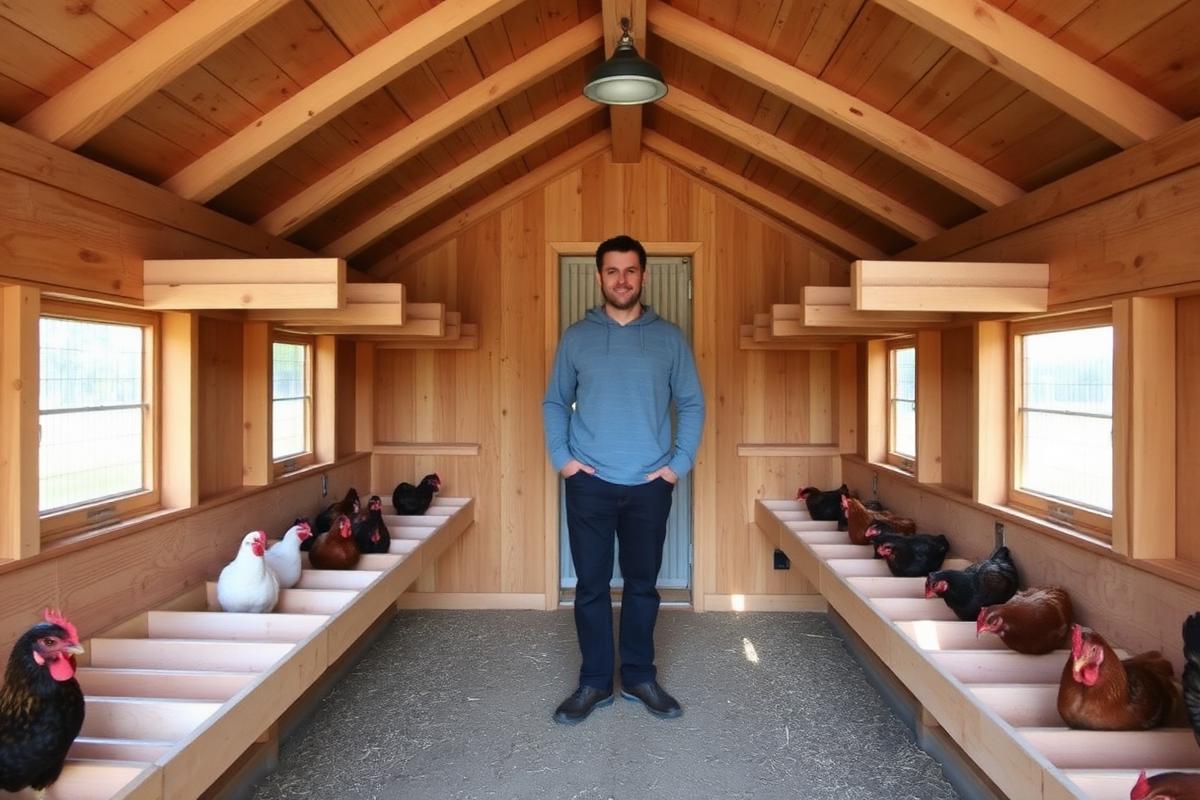
A walk-in chicken coop changes everything. If you’ve been hunched over, squeezing through a tiny door, or wrestling with feeders in a cramped space, you already know why. Working inside your coop—not around it—saves time, reduces stress, and keeps your birds healthier.
Browse our full collection of free chicken coop plans to compare every design by flock size, style, budget, and climate. The difference between a traditional coop and a walk-in design is simple: comfort. You can stand fully upright, move equipment without contortion, and actually observe your flock up close. A walk-in coop for 10–20 backyard hens is entirely manageable—it doesn’t require advanced carpentry skills. It is not, however, a cheap build: materials for a walk-in and its run land between $2,900 and $6,400 at 2026 prices, and anyone quoting you $800 is pricing a reach-in. For the full range of designs at every scale, see our complete chicken coop plans guide.
Our 8×8 coop with a screened run is the walk-in design in this class — 80 pages, full standing headroom, and an exterior nest bank. For a larger flock the 8×12 walk-in shed coop carries 14 to 18 hens with a built-in feed room.
Table of Contents
- Why Choose a Walk-In Coop?
- How to Size a Walk-In Coop
- Eight Walk-In Chicken Coop Plans
- Framing & Foundation Basics
- Roofing Options
- Ventilation Strategy
- Predator-Proofing
- Cost Breakdown by Coop Size
- Common Mistakes
- Frequently Asked Questions
Why Choose a Walk-In Coop Over Traditional Designs?
Traditional Coop Problems
- Stooped or crawling access
- Cramming feeders into corners
- Difficult to spot health issues
- Double your cleaning time
- Hard to winterize
Walk-In Advantages
- Stand-up access (6+ feet tall)
- Ergonomic equipment placement
- Line-of-sight flock observation
- Easier routine maintenance
- Room to upgrade systems
The real calculation isn’t about cost per square foot. It’s about whether you want to visit your flock or tolerate a quick chore. Most of us choose to visit.
How to Size a Walk-In Chicken Coop
Chickens need at least 4 square feet per bird inside the coop. We recommend 5 square feet per bird if you want breathing room. For the run, at least 10 square feet per bird.
Quick Sizing Guide
12 birds
48 sqft coop / 120 sqft run
→ 6x8 coop
16 birds
64 sqft coop / 160 sqft run
→ 8x8 coop
20 birds
80 sqft coop / 200 sqft run
→ 8x10 coop
We’ve built a chicken coop size calculator that does this math instantly.
Those are footprint numbers. A real walk-in loses floor to the door swing, the roost bank and — on the bigger designs — a partitioned feed room, so the flock figures on our plan pages below run lower than the raw square footage suggests. Build to the plan’s number, not the footprint’s.
Eight Walk-In Chicken Coop Plans
Every one of these is a shed-roof walk-in with full standing headroom, an exterior nest bank, and an attached screened run. Specs, dimensioned drawings and the complete cut list are free on each page; the full plan book is $4.99.
| Design | Bird floor | Flock | Build time | Materials |
|---|---|---|---|---|
| 6x8 walk-in chicken coop plans for 7-10 hens | 37 sq ft | 7–10 | 30–38 hrs | $2,900–$3,750 |
| 6x10 walk-in chicken coop plans for 9-12 hens | 47 sq ft | 9–12 | 36–44 hrs | $3,200–$4,100 |
| 8x8 walk-in chicken coop plans for 10-13 hens | 51 sq ft | 10–13 | 40–52 hrs | $3,200–$4,100 |
| 8x10 walk-in chicken coop plans for 12-14 hens | 66 sq ft | 12–14 | 46–58 hrs | $3,700–$4,750 |
| 8x12 walk-in chicken coop plans for 14-18 hens | 58 sq ft | 14–18 | 60–75 hrs | $4,250–$5,450 |
| 10x10 walk-in chicken coop plans for 15-17 hens | 84 sq ft | 15–17 | 60–78 hrs | $4,150–$5,350 |
| 10x12 walk-in chicken coop plans for 18-22 hens | 74 sq ft | 18–22 | 75–95 hrs | $4,700–$6,000 |
| 8x16 walk-in chicken coop plans for 19-26 hens | 79 sq ft | 19–26 | 90–110 hrs | $4,950–$6,400 |
The 8x12, 10x12 and 8x16 give up part of their footprint to a partitioned feed room, which is why their bird floor is smaller than the raw dimensions suggest — the 10x10 has more bird floor than the 8x12 despite being the smaller building.
Framing & Foundation Basics
All eight plans assume concrete piers or a post-and-beam setup rather than a full concrete slab. Dig 16 inches deep, fill with 4 inches of gravel, then 8 inches of concrete pier. Place pressure-treated 4x4 posts at each corner and every 4 feet along the length. Wall frames use standard 2x4 studs, 16 inches on center.
Plan for two entry points: one main human door (3 feet wide × 6 feet tall) and one egg collection door (2 feet wide × 3 feet tall, near the nesting boxes). For more detailed framing walkthroughs, see our complete guide to building a chicken coop.
Roofing Options
Corrugated metal roofing costs $1.50–2.50 per sqft installed, lasts 20–30 years, and drains excellently. For an 8x10 coop, you’re looking at $120–200 in roofing material alone. We use metal almost exclusively on walk-in coops. We recommend a 4:12 pitch minimum; for walk-in coops, aim for 6:12 or higher to gain interior height. For roofing specifics, check our chicken coop roofing guide.
Ventilation Strategy
You need at least 1 square foot of ventilation opening per 10 square feet of coop floor space. For an 8x10 coop: minimum 8 sqft of ventilation. Place high-side vents on the wall opposite the main door. Winter strategy: close lower vents 75%, keep high vents open. Never seal a coop completely. Our ventilation guide goes deep on air exchange rates.
Predator-Proofing for Walk-In Coops
Use 1/4-inch hardware cloth, not chicken wire. Cover entire exterior walls from the floor up to 18 inches high. Extend hardware cloth 12 inches out and down from the foundation perimeter. Use slide bolt or carabiner latches. See our predator-proof coop guide for detailed predator-by-predator breakdown.
Cost Breakdown by Coop Size
These are materials only, priced off the bill of materials in each plan at 2026 lumber prices, and they include the attached screened run, the piers, the metal roof and the hardware cloth — not just the coop box. A walk-in is a real framed building; the sub-$1,000 figures you see quoted around the web are usually a reach-in coop, or lumber with the roof and wire left out.
| Coop size | Materials (DIY) | Bird floor |
|---|---|---|
| 6x8 walk-in + 6x10 run | $2,900–$3,750 | 37 sq ft |
| 8x8 walk-in + 8x10 run | $3,200–$4,100 | 51 sq ft |
| 8x10 walk-in + 8x12 run | $3,700–$4,750 | 66 sq ft |
| 10x12 walk-in + 10x16 run | $4,700–$6,000 | 74 sq ft |
| 8x16 walk-in + 8x20 run | $4,950–$6,400 | 79 sq ft |
Hiring the build out typically doubles these; labour, not material, is the bigger line on a structure this size.
For line-by-line 2026 pricing on a smaller build, our chicken coop cost breakdown itemizes a real 4x8. For sourcing, see the chicken coop materials list.
Common Mistakes We See Backyard Builders Make
- Skimping on ventilation kills birds faster than cold.
- Using chicken wire instead of hardware cloth lets raccoons tear through in minutes.
- Building on solid concrete wicks moisture into wood, causing rot in 5–7 years.
- Making the main door too small means you’ll avoid using the coop. Go for 3x6 minimum.
- Underestimating nesting box needs causes pecking stress—plan for 1 box per 3 birds.
- Poor roof slope (under 4:12) causes leaks and interior moisture.
Build Once, Enjoy for Years
Start with an 8x10 if you’re unsure. It’s the Goldilocks size: big enough to feel genuinely walk-in, small enough to build in a weekend or two. Grab our large coop plans guide for additional design variations, or use our size calculator to confirm dimensions for your flock.
The pattern worth knowing: reach-in coops are cheaper to build and more expensive to live with. Every cleanout, every sick bird, every winter water check happens on your knees.