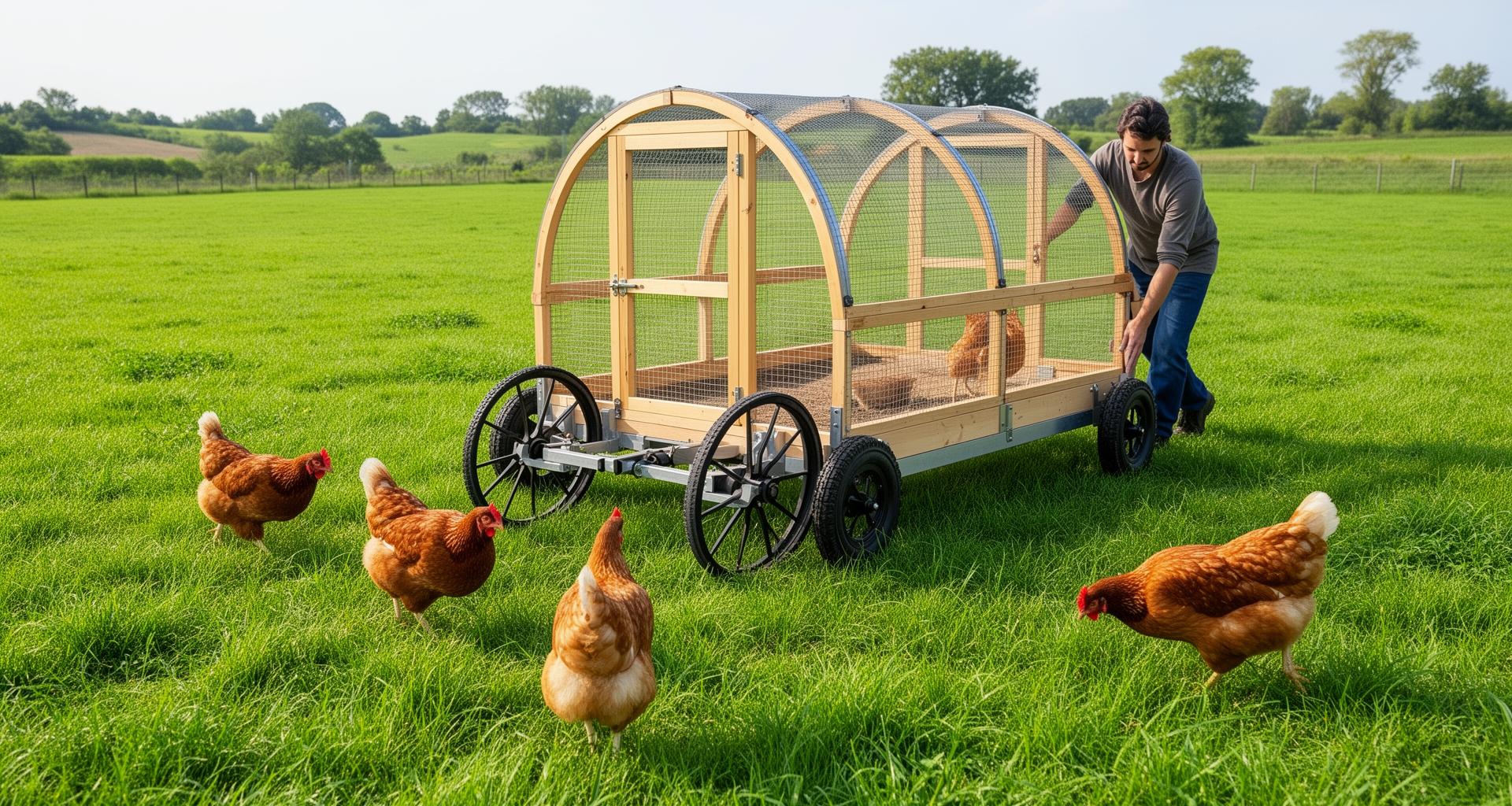
If you’re searching for mobile chicken coop plans, you’re probably not just trying to “house chickens”—you’re trying to move the flock. A chicken tractor lets birds harvest fresh forage, spread manure evenly, disrupt pests, and reduce mud issues—while you control where the impact happens.
Browse our full collection of free chicken coop plans to compare every design by flock size, style, budget, and climate.
The Chicken Tractor Formula
Light enough to move + Strong enough to survive + Ventilated + Dry + Predator-resistant
When those five are in balance, rotational grazing becomes ridiculously easy.
Most common failure: A tractor that’s “moveable” on day one, then becomes a back-breaking drag once it gets heavier, warped, or muddy.
Best Tractor Design Types
“Chicken tractor” means different things to different people. The best mobile chicken coop plans are the ones that match your movement style, not just your flock size.
Design Type What It Is Best For Tradeoffs
Low Dome/Hoop Light, low profile, arched top Meat birds, daily moves, low cost Less headroom, harder access
A-Frame Triangular frame, simple build Small flocks, basic grazing Awkward access; door placement matters
Box with Wheels Rectangular “mini shed” on wheels Layers with roosts/nesting Can become heavy
Split (Coop + Run) Mobile coop plus separate run High predator areas; flexible More parts to manage
Skid-Based Tow Heavier structure dragged by ATV Larger flocks; less hand labor Can tear turf; needs good tow geometry
Rule of thumb: If you can’t move it in under 3-5 minutes, you won’t do it every day in bad weather.
Mobility Mechanisms: The Most Important Section
A tractor can be beautiful, roomy, and perfectly ventilated—but if moving it is miserable, rotational grazing dies. Mobility is a design system: wheels, balance, handholds, tow geometry, and ground contact edge.
Wheel Placement
Goal: When you lift the handle, you should feel like you’re lifting a small percentage of total weight.
- • Place heavy items near the wheel axis
- • Bigger diameter wheels roll over ruts better
- • Leverage beats brute force
Wheels vs Skids
Wheels: Best for frequent hand moves, less friction on grass.
Skids: Great for tow moves, but can tear turf if too heavy.
Hybrid: Skids support frame, wheels lift/roll during movement.
Tow Bars
If the tow point is too high or low, it can twist the frame during movement.
- • Keep tow forces centered on structural members
- • V-shaped tow bar reduces twisting
- • Mind the angle—steep pulls dig the front edge
Anti-Gap Edges
Uneven ground creates gaps where birds escape and predators enter.
- • Flexible skirt closes small gaps
- • Smooth lower edge conforms better
- • Stakes/clips for nights or predator areas
Predator Safety Without Extra Weight
Predator pressure is the design constraint that fights mobility. The trick is layering protection without building a tank you can’t move.
Low Pressure
Urban yards, minimal wildlife. Main risks are dogs. Lightweight tractors work well if edges fit the ground.
Medium Pressure
Raccoons, foxes, stray dogs sometimes. Plan for secure nighttime lock-up and stronger mesh in key areas.
High Pressure
Coyotes, frequent predator visits. Combine tractor with electric net or mobile coop with protected run.
Reality check: A mobile chicken coop plan that claims “predator-proof” without describing edge gaps, latches, and nighttime security is marketing, not engineering.
Soil Benefits & How to Avoid Damage
Key Soil Benefits
- • Even manure distribution improves fertility
- • Insect disruption reduces pests
- • Scratching breaks down thatch
- • Moving impact zones encourages plant diversity
How Tractors Damage Soil
- • Bare soil + mud: Staying too long in wet seasons
- • Nutrient overload: Too many birds or returning too quickly
- • Fix: Shorten stays, reduce density, longer rest periods
Soil-friendly principle: Move before the ground looks stressed, not after.
Frequently Asked Questions
How often should I move a chicken tractor for rotational grazing?
Daily moves are most common because they prevent mud and overgrazing. If your tractor footprint is large relative to your flock, moving every 2-4 days can work. In wet conditions, move more often. If the ground looks stressed, shorten the stay.
What’s the biggest mistake in mobile chicken coop plans?
Underestimating weight and overestimating how often you’ll move it. A tractor that’s hard to move becomes stationary, and then pasture damage and odor problems start. Design for the worst day—if it’s only easy when dry and clean, it’s not truly “mobile.”
Can a mobile coop be predator-proof?
It can be predator-resistant, but “proof” depends on predator pressure and edge gaps. Many setups combine a tractor with secure nighttime lock-up and a portable perimeter (like electric net) to keep the tractor light.
Do chicken tractors really improve soil?
Yes, when managed well. The key is controlled impact: short stays, adequate rest periods, and avoiding the same spots too frequently. Done right, you get even manure distribution, pest reduction, and improved pasture diversity.
Bottom Line
The best mobile chicken coop plans are the ones that you will actually move in real life. Prioritize mobility mechanisms (wheel size, balance, tow geometry), then build your rotation schedule around pasture recovery. Done right, a chicken tractor turns “chicken chores” into a simple habit and converts your flock into a soil-improvement tool.