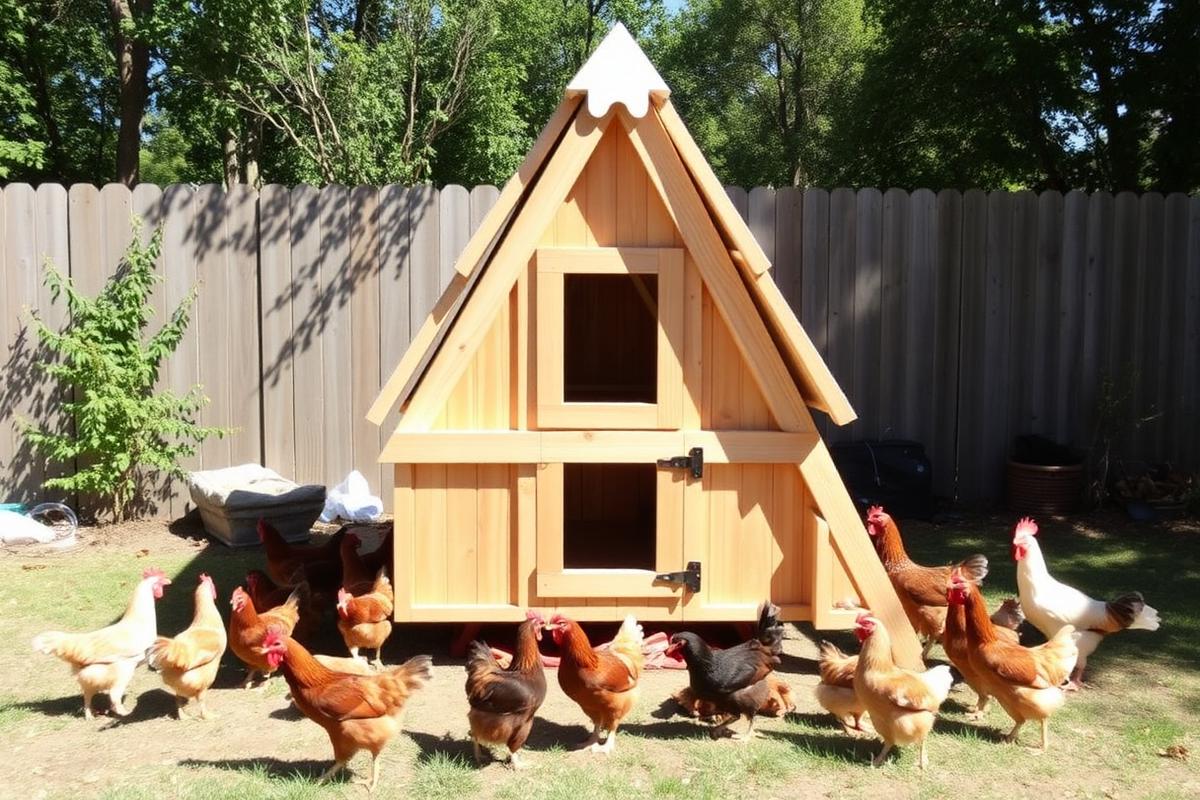
If you’re looking to raise a handful of backyard chickens without spending a fortune or burning a week on construction, an A-frame coop is honestly your best move. We’ve built a few of these over the years, and the simplicity is part of the appeal: two triangular walls, a peaked roof that pulls double duty as your structure, and enough space for 3–5 hens.
You’re looking at roughly $100–200 in lumber, a weekend of work, and a coop that’ll last years if you build it right. In this guide, we’re sharing three free plans—from the bare-bones starter to a mobile version on wheels—plus the honest truth about where A-frames shine and where they fall short. For more designs at every scale, see our complete chicken coop plans guide.
If you want full standing headroom instead of the A-frame’s crouch, compare it against the 8×12 walk-in shed coop or the 8×8 walk-in set — both publish complete specs and cut lists free on the page.
Table of Contents
- What Is an A-Frame Chicken Coop?
- A-Frame Pros and Cons (Honest Version)
- Space Requirements
- 3 Free A-Frame Chicken Coop Plans
- Materials List
- Predator-Proofing
- Is an A-Frame Right for You?
- Frequently Asked Questions
What Is an A-Frame Chicken Coop?
An A-frame coop is about as simple as chicken housing gets. Picture two triangular end walls connected by a ridge beam running the length of the structure—and that peaked roof IS your walls. There’s no separate wall-and-roof assembly. The geometry is what makes it clever: both sides of the peaked roof form the coop walls, so you’re doing less carpentry, using less lumber, and ending up with a structure that’s surprisingly rigid.
A typical A-frame runs about 8 feet long with a 4-foot base and a 4-foot peak height. That gives you roughly 32 square feet of footprint, though the usable floor space is closer to 20 square feet because the walls slope inward. The peaked design sheds rain and snow naturally without pooling.
What we like most is the material efficiency. You’re cutting only 6–8 major pieces. Compare that to a rectangular coop with separate walls and a pitched roof, and you’re looking at far fewer cuts and significantly less waste.
A-Frame Pros and Cons (Honest Version)
✅ Why We Recommend A-Frames
- Cheapest coop you can build ($100–200)
- Fewest cuts of any coop style
- Inherently stable — weight distributes naturally
- Peaked roof sheds water and snow without gutters
- Movable if built on skids
- Comfortably houses 3–5 laying hens
❌ Where A-Frames Fall Short
- Low headroom — you cannot stand inside
- Nesting box placement is less flexible
- Insulation for cold climates is harder to add
- Predator-proofing the end walls requires attention
- Maxes out at around 4–5 hens comfortably
- Larger breeds find sloped walls annoying
Space Requirements for an A-Frame Coop
A standard 4x8 A-frame gives you about 32 square feet of footprint, but usable floor space is roughly 20 square feet. Hens need a minimum of 3–4 square feet per bird. That means a standard A-frame can safely house 5 hens if they have outdoor space to roam.
Ventilation is critical in an A-frame. Build hardware-cloth-backed vents into both triangular end walls. These should total at least 1 square foot of vent space per bird. For sizing details, check our chicken coop size calculator.
3 Free A-Frame Chicken Coop Plans
Plan 1: The Simple 4x8 A-Frame ($100–150)
Houses: 3–4 hens | Skill: Beginner | Build time: 6–8 hours
This is the starter—the coop we recommend for anyone building their first shelter. 4 feet wide at the base, 8 feet long, with a 4-foot peak. Materials: Four 2x4x8 boards for base and ridge, eight 2x4x10 boards for the roof walls, one 4x8 sheet of siding, 50 linear feet of 1/2-inch hardware cloth, roofing material, two heavy-duty latches, and exterior screws.
Why we like it: Cheapest option, fewest cuts, straightforward angles, no special tools needed.
Plan 2: The Raised A-Frame with Enclosed Run ($200–300)
Houses: 4–5 hens | Skill: Intermediate | Build time: 12–16 hours
Same A-frame but elevated 24 inches on 4x4 posts, then enclosing a 4x8 run underneath. Chickens live in the elevated coop at night and can access the enclosed run below during the day.
Why we like it: The enclosed run keeps hens out of rain and sun, reduces predator access, and the elevated coop stays cleaner and drier.
Plan 3: The Mobile A-Frame Tractor ($250–400)
Houses: 3–4 hens | Skill: Intermediate | Build time: 8–10 hours
A chicken tractor built on a frame with wheels or skids so you can move it across your yard. We build ours 4 feet wide and 6 feet long to keep the weight manageable for one person.
For detailed mobile coop plans, visit our mobile chicken coop plans guide.
Materials List for a Basic A-Frame Coop
Here’s what you’ll buy for Plan 1 (the simple 4x8 A-frame):
Lumber
- 4 × 2x4x8 boards (base and ridge)
- 8 × 2x4x10 boards (angled roof walls)
- 2 × 2x6 boards (optional, for door frame)
Siding & Roofing
- 1 × 4x8 sheet T1-11 or OSB siding
- Corrugated roofing panels or shingles
- Roofing nails/screws
Hardware
- 50 linear ft of 1/4” hardware cloth
- 3” exterior wood screws (5-lb box)
- Heavy-duty staples or screws for mesh
Hinges & Latches
- 2 × heavy-duty strap hinges
- 2 × predator-proof latches (slide bolt)
- Hook-and-eye backup latches
Estimated cost: $100–180. For detailed pricing, see our chicken coop plans with materials list guide and coop materials guide.
Predator-Proofing an A-Frame
The triangular end walls are the vulnerability. Cover every opening with 1/4-inch hardware cloth—not chicken wire, and not 1/2-inch either. Half-inch genuinely stops raccoons, but a least weasel squeezes through anything 1/4 inch or larger (Univ. of Kentucky Extension ID-245). Bury a 12-inch apron around the perimeter. Use two-step latches on every door. Back all ventilation openings with hardware cloth. And close the coop every night at dusk. Full details in our predator-proof coop guide.
Is an A-Frame Right for You?
Yes, build an A-frame if:
- You’re keeping 3–5 hens
- This is your first coop build
- Your budget is under $300
- You’re willing to bend to access nesting boxes
- You live in a mild-winter climate
- You like the idea of a mobile coop
No, skip the A-frame if:
- You’re planning for 6+ hens
- You live somewhere with harsh, freezing winters
- You have mobility issues and need walk-in access
- You prefer a larger coop with headroom
Try our walk-in coop plans or 4x4 coop plans instead.
Get Started on Your A-Frame Build
If this is your first coop, start with Plan 1. It’s forgiving, fast, and you’ll learn the basics without overcomplicating things. Want to verify your coop size matches your flock? Use our chicken coop size calculator. And when you’re ready to explore more options, browse our full collection of chicken coop plans.