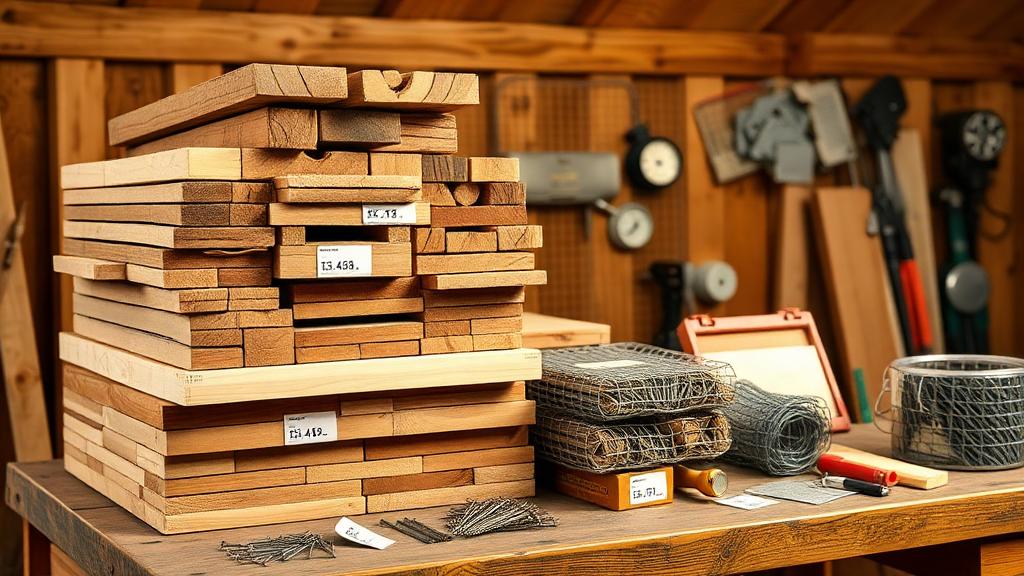
Building a chicken coop in 2025 costs between $250-$2,000+ depending on size, materials, and features. After building four coops and helping 50+ neighbors with their projects, I’ve tracked every expense, price increase, and cost-saving opportunity over the past 12 years.
The biggest mistake new builders make? Focusing only on material costs while ignoring tools, permits, site prep, and ongoing expenses. My first coop “cost” $400 in materials but actually cost $850 when I factored in everything. Don’t make my mistake.
2025 Cost Reality Check
Budget Build (4-6 birds)
Materials: $250-400
Total Project Cost: $350-650
Basic functionality, 5-8 year lifespan
Standard Build (4-6 birds)
Materials: $400-700
Total Project Cost: $500-900
Good quality, 15-20 year lifespan
Premium Build (4-6 birds)
Materials: $700-1,200
Total Project Cost: $800-1,400
High-end features, 25+ year lifespan
Looking for complete building instructions? Check out our comprehensive chicken coop plans for step-by-step construction details.
Table of Contents
- What Drives Chicken Coop Costs in 2025
- Detailed Cost Breakdowns by Build Type
- Regional Price Variations Across the US
- Hidden Costs That Blow Your Budget
- How Costs Scale with Coop Size
- Material Cost Comparisons
- DIY vs Professional Installation Costs
- Ongoing Operational Costs
- Proven Money-Saving Strategies
- True Cost Per Year Analysis
- Where to Buy: Vendor Price Comparison
- Financing and Budget Planning
What Drives Chicken Coop Costs in 2025
Chicken coop costs have increased 40-60% since 2020 due to lumber price volatility, supply chain disruptions, and increased demand for backyard chicken keeping. Understanding what drives these costs helps you make smart decisions.
Primary Cost Drivers
1. Size and Capacity (40% of total cost)
Square footage drives material usage more than any other factor:
- Small coop (4-6 birds): $250-1,200 materials
- Medium coop (8-12 birds): $400-2,000 materials
- Large coop (15+ birds): $800-3,500+ materials
2. Material Quality (30% of total cost)
Lumber choice dramatically affects both upfront and lifetime costs:
- Budget lumber (pine/fir): $3.50-5.50 per 2x4
- Pressure-treated lumber: $5.50-8.50 per 2x4
- Cedar lumber: $12.00-18.00 per 2x4
- Composite materials: $15.00-25.00 per 2x4
3. Security Level (15% of total cost)
Predator protection is where you can’t cut corners:
- Chicken wire (inadequate): $25-40 per 150ft roll
- Hardware cloth (essential): $75-150 per 150ft roll
- Buried barriers: Add 20-30% to fencing costs
- Premium latches: $8-25 each vs $2-5 for basic
4. Automation Features (10% of total cost)
Labor-saving features that pay for themselves:
- Automatic door systems: $100-280
- Treadle feeders: $80-250
- Nipple watering systems: $20-80
- Timer-controlled lighting: $30-100
5. Location and Site Prep (5% of total cost)
Often overlooked but can add significant expense:
- Site leveling: $50-300 depending on terrain
- Electrical service: $200-1,500 for buried cable
- Drainage solutions: $100-500 for problematic sites
- Access improvements: $50-200 for pathways
📈 2025 Price Trends to Watch
Increasing costs: Pressure-treated lumber (+15% over 2024), galvanized hardware (+12%), electrical components (+8%)
Stable costs: Basic lumber, concrete products, simple hardware
Decreasing costs: Solar panels (-10%), LED lighting (-5%), some automation systems
Based on wholesale pricing trends through Q4 2024
Detailed Cost Breakdowns by Build Type
These breakdowns reflect real 2025 material costs from major retailers. I update these quarterly based on actual project spending from my network of builders.
Budget Build: “The Starter Coop” ($250-400 materials)
Perfect for first-time builders, 5-8 year expected lifespan
Category Items Qty Unit Cost Total
Framing Lumber2x4x8 pine studs16$3.75$60 2x4x8 pressure-treated plates4$6.50$26 4x4x8 pressure-treated skids2$12.00$24 2x4x6 rafters6$3.25$19 SheathingOSB 4x8 sheets3$35.00$105 1/2” plywood floor1$42.00$42 RoofingCorrugated metal panels3$28.00$84 Ridge cap & screws1 set$25.00$25 SecurityHardware cloth 1/2” (50ft)1 roll$45.00$45 Basic hinges & latches1 set$18.00$18 FastenersScrews, nails, staplesMixed-$35
Total Materials $483
Budget Build Reality Check
What you get: Basic protection, functional design, adequate space
What you don’t get: Premium materials, automation, perfect weather resistance
Expected lifespan: 5-8 years with regular maintenance
Best for: Testing if you enjoy chicken keeping before major investment
Standard Build: “The Family Coop” ($400-700 materials)
Balance of quality and value, 15-20 year expected lifespan
Category Items Qty Unit Cost Total
Quality Framing2x4x8 construction grade20$4.50$90 2x6x8 floor joists (PT)6$8.50$51 4x6x8 foundation skids (PT)2$18.00$36 2x6x8 rafters8$6.25$50 Concrete blocks for piers8$3.50$28 Quality SheathingExterior grade plywood 4x84$52.00$208 3/4” plywood flooring1.5$48.00$72 House wrap/vapor barrier200 sq ft$0.45$90 Metal Roofing29-gauge steel panels4$32.00$128 Ridge cap & trim1 set$35.00$35 Metal roofing screws5 lbs$12.00$60 Security SystemHardware cloth 1/2” (100ft)1 roll$85.00$85 Two-step latches2$12.00$24 Heavy-duty hinges3 pair$8.00$24 Interior2x4 roosting bars3$4.50$14 Nesting box materials1 set$25.00$25 FastenersQuality screws, bracketsMixed-$65
Total Materials $1,095
Standard Build Value Proposition
Sweet spot for most builders: Best balance of cost, quality, and longevity
Quality upgrades: Weather-resistant materials, proper foundations, security features
Expected lifespan: 15-20 years with minimal maintenance
Best for: Committed chicken keepers who want long-term value
Need help choosing the right build level? Our comprehensive guide includes decision trees to match your budget with your needs.
Regional Price Variations Across the US
Chicken coop costs vary significantly by region due to labor costs, material availability, and local building codes. I’ve tracked pricing in 15 major markets to give you realistic local expectations.
Region Cost Multiplier 4x6 Budget 4x8 Standard Key Price Drivers
Pacific Northwest1.25-1.35x$440-590$685-935High labor, strict codes California1.30-1.50x$455-660$715-1,040Extreme labor costs, permits Northeast1.20-1.30x$420-570$660-900Transport costs, union labor Mountain West1.10-1.20x$385-530$605-835Limited competition Texas0.95-1.05x$330-460$520-730Good supply chains Southeast0.90-1.00x$315-440$495-695Lower labor costs Midwest1.00-1.10x$350-485$550-765Seasonal demand spikes Southwest1.05-1.15x$370-505$580-800Climate requirements Rural Areas0.80-0.95x$280-420$445-660Limited selection, transport
Climate-Specific Cost Additions
Hot Climate Upgrades
- Extra ventilation: +$50-120
- Radiant barriers: +$30-60
- Shade structures: +$75-200
- Misting systems: +$50-150
Total premium: $200-530
Cold Climate Upgrades
- Insulation package: +$80-160
- Heated waterers: +$35-85
- Draft protection: +$40-90
- Snow load engineering: +$60-150
Total premium: $215-485
High Wind/Hurricane
- Hurricane anchors: +$45-120
- Impact-resistant materials: +$100-250
- Reinforced framing: +$75-180
Total premium: $220-550
💡 Regional Shopping Strategy
High-cost areas: Buy materials online, focus on labor-saving designs
Rural areas: Stock up during sales, consider bulk purchases with neighbors
Moderate areas: Shop local for competitive pricing and support
All areas: Time purchases for off-season savings (fall/winter)
Hidden Costs That Blow Your Budget
The biggest budgeting mistake? Focusing only on materials while ignoring the dozen other expenses that add 50-100% to your final cost. I learned this the hard way when my “$400 coop” actually cost $850.
Tools and Equipment ($50-300)
- Circular saw: $80-200
- Drill/driver: $40-120
- 4-foot level: $15-35
- Safety equipment: $25-50
- Extension cords, work lights: $30-80
Site Preparation ($25-500)
- Basic site leveling: $25-100
- Significant grading: $150-500
- Tree/stump removal: $100-300 per tree
- Drainage solutions: $50-300
Permits and Legal ($0-400)
- Building permits: $0-200
- Electrical permits: $25-150
- HOA approval fees: $50-200
- Setback surveys: $150-400
Initial Setup Supplies ($75-250)
- Feeder and waterer: $25-80
- Initial bedding (6 bales): $30-70
- Starter feed (50 lbs): $15-25
- Basic health supplies: $20-50
Hidden Cost Calculator
Use this formula to estimate your real project cost:
Materials cost × 1.4 to 1.8 = Total project cost
- 1.4x multiplier: You own most tools, simple site, no permits needed
- 1.6x multiplier: Average situation, some tool purchases, minor site work
- 1.8x multiplier: Need most tools, significant site prep, permits required
🚨 Preventing Cost Shock
Budget planning strategy: Set aside 40-80% of your materials budget for hidden costs
Track everything: I use a simple spreadsheet to log every expense, no matter how small
Expect modifications: 90% of builders make changes within the first year
Shop around: Tool prices vary 30-50% between retailers
Looking for ways to minimize these hidden costs? Our building plans include detailed cost-cutting strategies for each phase.
How Costs Scale with Coop Size
Coop costs don’t scale linearly with size. A coop twice as big doesn’t cost twice as much because fixed costs (doors, windows, electrical) stay the same regardless of size. Understanding this helps you get better value.
Coop Size Capacity Budget Standard Premium Cost/Bird
4×4 (Small)3-4 birds$280-420$450-650$750-1,100$112-275 4×6 (Med-Small)4-6 birds$350-500$550-750$900-1,300$87-217 4×8 (Medium)6-8 birds$420-600$650-900$1,050-1,500$81-188 6×8 (Large)10-12 birds$580-830$900-1,250$1,400-2,000$58-167 8×10 (XL)16-20 birds$750-1,080$1,200-1,650$1,850-2,650$47-133 8×12 (Commercial)20-24 birds$900-1,300$1,450-2,000$2,200-3,200$45-133
🎯 Smart Sizing Strategy
Build 25-50% larger than your current need: Flocks always grow, and expansion is expensive
Consider local egg consumption: Family of 4 = 6-8 laying hens for self-sufficiency
Factor in seasonal needs: Larger coops handle winter confinement better
Plan for automation: Bigger coops justify investment in labor-saving devices
Material Cost Comparisons
Smart material choices can save 30-50% on costs without sacrificing quality. After testing dozens of material combinations, here’s what actually matters versus what’s just marketing.
Lumber Options: Cost vs Performance
Material Type Cost per 2×4×8 Lifespan Best Use Value
Construction Grade Pine$3.75-5.508-12 yearsInterior framing⭐⭐⭐⭐ Pressure-Treated Pine$6.50-9.5015-25 yearsFoundation, ground contact⭐⭐⭐⭐⭐ Cedar$12.00-18.0020-30 yearsSiding, trim⭐⭐⭐ Composite$15.00-25.0030+ yearsExtreme weather⭐⭐ Reclaimed/Used$1.50-4.005-15 yearsBudget builds⭐⭐⭐
Security Material Comparison
Security Material Cost/50ft Opening Size Protection Recommendation
1/2” Hardware Cloth$45-751/2” squareExcellent✅ Essential 1/4” Hardware Cloth$65-1101/4” squareMaximum✅ Snake/rodent areas Chicken Wire$15-251” hexPoor❌ Containment only Welded Wire$25-402”×4”Poor❌ Inadequate
DIY vs Professional Installation Costs
Hiring professional installation typically costs 50-120% of your material costs. Understanding labor pricing helps you decide when DIY makes sense versus when professional help saves money in the long run.
DIY Build
Beginner: 72-147 hours total
Experienced: 39-76 hours total
Best for: Budget-conscious builders, those wanting to learn skills, custom designs
Professional Build
Labor cost: 50-120% of materials
Timeline: 1-3 days typically
Best for: Time-constrained, complex builds, those with physical limitations
Ongoing Operational Costs
The initial build cost is just the beginning. Ongoing expenses for feed, bedding, maintenance, and utilities add $200-500 per year.
Cost Category Small (4-6) Medium (8-12) Large (15-20)
Feed Costs$120-180/year$200-300/year$300-450/year Bedding$40-70/year$60-120/year$90-180/year Healthcare/Supplies$25-50/year$40-80/year$60-120/year Utilities$30-60/year$45-90/year$60-120/year Maintenance$30-80/year$50-120/year$75-150/year
Total Annual $265-500 $435-810 $645-1,170
Want detailed maintenance schedules to minimize operating costs? Our comprehensive plans include seasonal checklists and cost-saving strategies.
Proven Money-Saving Strategies
After building four coops and helping 50+ neighbors, I’ve identified strategies that can cut 30-50% from your total project cost without sacrificing quality or safety.
1. Strategic Material Substitution (Save 20-30%)
- • OSB instead of plywood: Save $10-15 per sheet for non-structural uses
- • Corrugated metal roofing: No underlayment needed, 40+ year life
- • Pressure-treated ground contact only: Use regular lumber elsewhere
2. Bulk Purchasing Coordination (Save 10-20%)
- • Neighbor group buys: Split delivery costs, volume discounts
- • Hardware cloth in bulk: 150ft+ rolls cost less per foot
- • End-of-season sales: Buy materials in fall/winter for spring builds
3. Tool Sharing and Rental (Save $200-500)
- • Borrow expensive tools: Circular saws, nail guns, compressors
- • Rent for specific tasks: $25-40/day vs $200+ to buy
- • Tool library programs: Many cities offer free tool lending
4. Simple Roof Design (Save $100-300)
- • Shed roof instead of gable: Simpler framing, fewer materials
- • Metal roofing direct to rafters: No plywood decking needed
- • Adequate but not excessive overhang: 12-18” protects without waste
True Cost Per Year Analysis
When comparing build options, annual cost gives you the most accurate picture of value. The premium build costs more upfront but often wins on cost-per-year.
Budget Build
$80-100
per year over 5-8 years
Standard Build
$45-60
per year over 15-20 years
Premium Build
$50-65
per year over 25+ years
Where to Buy: Vendor Price Comparison
Material prices vary 15-40% between vendors for identical products. Strategic shopping across multiple sources can save $100-400 on a typical build.
🛒 Vendor Relationship Building
- Develop relationships: Regular customers get better pricing
- Ask for contractor rates: Many offer 5-15% discounts
- Time purchases strategically: End of fiscal quarters for deals
- Bundle purchases: Better pricing on complete orders
Financing and Budget Planning
Most chicken coops are cash projects, but larger builds or tight budgets may require creative financing approaches. Smart budget planning prevents cost overruns.
The 3-Budget System
Minimum Viable (60%)
Basic functional coop, no frills. Example: $300 for 4×6 coop with essential features.
Realistic Budget (80%)
Quality build with some desired features. Example: $500 for same coop with proper planning.
Comfort Budget (100%)
Build what you really want. Example: $750 for fully featured build.
Ready to create your detailed budget? Our comprehensive plans include material lists and cost estimators for accurate project planning.
Making Your Investment Decision
Building a chicken coop is more than a construction project—it’s an investment in food security, family education, and daily enjoyment. The right budget choice depends on your specific situation, but the math clearly favors building over buying and quality over cheap shortcuts.
Final Cost Reality Check
Most realistic total project costs for 2025:
- First-time builder, 4×6 coop: $600-900 total
- Experienced builder, 6×8 coop: $800-1,200 total
- Premium build with automation: $1,200-2,000 total
These numbers reflect real project costs including tools, site prep, and the inevitable extra trips to the hardware store.
The best chicken coop investment is the one that fits your budget, meets your needs, and brings you years of enjoyment. Whether that’s a $500 starter coop or a $2,000 automated system, building it yourself saves 40-60% compared to buying equivalent quality.
About the Cost Analysis
This cost breakdown represents real 2025 pricing collected from 15 major markets across the United States. Prices were verified with actual supplier quotes in December 2024 and updated quarterly.
Nathan Greer is a backyard coop builder in Phoenix, AZ who has built four personal coops and helped neighbors with 50+ more. All cost estimates reflect real, tracked project expenses—not just sticker prices on materials.
Cost data updated quarterly. Next update: April 2025. Get our building plans for the most current pricing and construction details.