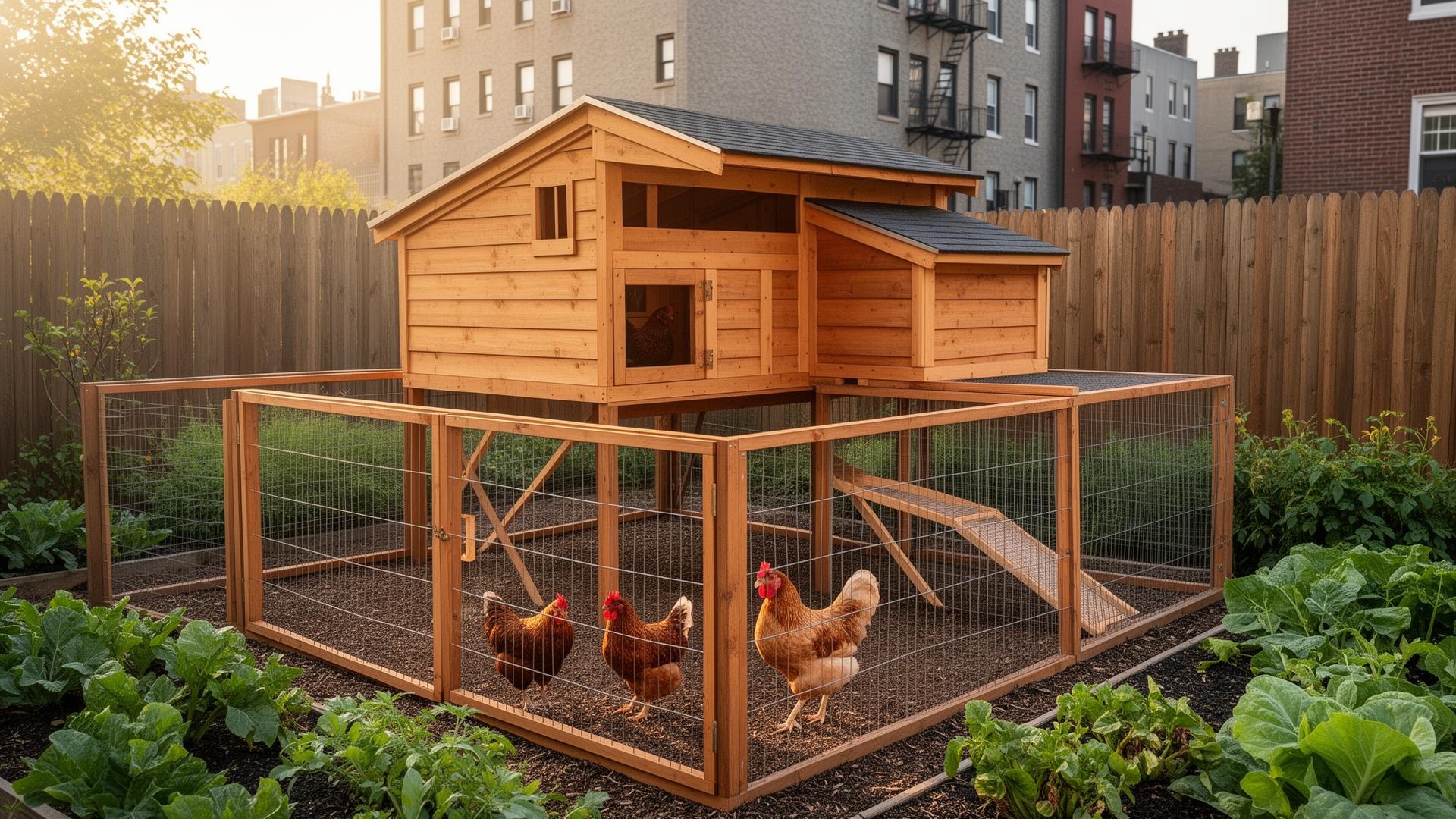
A small yard doesn’t change chicken biology. It changes how carefully you have to lay the coop out. Every hen still needs the same floor space, the same roost inches and the same air exchange as a hen on ten acres.
What a small lot demands is a raised floor and a footprint that lines up with standard lumber. It also demands placement that keeps you legal and your neighbors quiet. This guide covers all three, plus the urban-specific problems that don’t come up on an acreage: setbacks, noise, aesthetics and cleaning access you can actually reach.
Two plan sets fit most small yards. The 4x6 coop gives 16 sq ft of usable floor for three or four hens. The 4x4 starter coop drops to a 4-foot square for two or three. Both raise the floor so the run tucks underneath instead of eating more lawn. Free preview PDFs and full spec tables sit on each plan page; the complete books are $4.99 each on Etsy.
Space Requirements Don’t Shrink With Your Lot
Each standard hen needs 3-4 sq ft of coop floor plus 8-10 sq ft of run. Those figures come from Oregon State Extension EC 1644, Penn State and Virginia Tech, and they hold regardless of your property size.
The trap is counting outside dimensions. A 4x6 coop is 24 sq ft on the outside and about 16 usable once you subtract framing and the nest bank. Always size from the usable number.
| Flock | Usable coop floor | Run | Total yard footprint |
|---|---|---|---|
| 3 hens | 12 sq ft | 24-30 sq ft | ~40 sq ft |
| 4 hens | 16 sq ft | 32-40 sq ft | ~56 sq ft |
| 6 hens | 24 sq ft | 48-60 sq ft | ~84 sq ft |
| 8 hens | 32 sq ft | 64-80 sq ft | ~112 sq ft |
Any plan claiming more than one bird per 3-4 sq ft of coop floor is overselling. Crowding shows up as feather-pecking and respiratory illness, and it shows up faster in a small space. Check your own numbers with the chicken coop size calculator.
One counter-intuitive point worth holding onto: birds with no outdoor access need 8-10 sq ft of indoor floor each, roughly double. Space needed goes up when the run goes away.
Build Up, Not Out
A raised coop is the single highest-value move on a small lot. It buys you a second use for the same square footage.
- The bay underneath becomes run. Shaded, dry, and genuinely usable — it counts toward the 8 sq ft per bird outdoor figure.
- Ground predators lose their easy approach. Colorado State Extension recommends raising a coop about a foot off the ground to discourage rats, skunks and snakes. Eighteen inches or more is better under rat pressure.
- Air moves under the floor. That keeps the deck dry and slows rot.
- You get storage. Feed bins and tools live under the coop instead of in your shed.
Our plans run the floor 18 to 24 inches off grade, which clears both thresholds. Give the ramp cleats every few inches and keep the angle gentle — chickens are poor climbers on smooth, steep boards.
Roosting above nest boxes is the other vertical win. It stacks two functions in one wall and keeps birds off the boxes at night, which is what stops fouled eggs. Never site a box directly under a roost bar.
Footprints That Fit a Small Yard
Rectangles beat squares in tight spaces. A 4x8 gives you 32 sq ft along an 8-foot fence line. The equivalent square lands on 5’8” dimensions that waste lumber and fight your fence panels.
Design to standard 8, 12 and 16-foot lengths. Sheet goods come in 4x8, so footprints in multiples of 4 feet cut waste and put every seam on framing.
| Configuration | Total yard footprint | Birds |
|---|---|---|
| 4x4 coop + run under and beside | 4 x 8 (32 sq ft) | 2-3 |
| 4x6 coop + 4x6 run | 4 x 12 (48 sq ft) | 3-4 |
| 4x8 coop + 4x8 run | 4 x 16 (64 sq ft) | 4-6 |
| 6x8 coop + 6x8 run | 6 x 16 (96 sq ft) | 6-9 |
Plans That Match Those Footprints
Against a fence or garage wall: the 4x8 lean-to coop has a single-slope roof and a low profile, holds 4-6 hens, and runs $2,100-$2,750 in materials. It’s the least visually intrusive build in the line.
Freestanding, mid-size: the 4x8 shed coop gives the same 4-6 hen capacity with 23 sq ft of floor and 60 inches of roost, at $2,250-$2,900.
When the coop has to look intentional: the 6x8 modern coop is board-and-batten with a mono-pitch roof, sized for 7-10 hens. It reads as a garden structure rather than a farm building, which matters when it’s visible from a neighbor’s patio.
On a tight budget: the 6x8 pallet coop is framed in real lumber and clad in free pallet board. Same 7-10 hens for $2,850-$3,800, and it looks deliberate rather than scrapped together.
When you want the ground to recover: the 4x10 cattle-panel hoop tractor moves. Two to four hens, $1,000-$1,300, and your lawn gets scratched and fertilized in rotation instead of turned to bare dirt in one spot.
Placement on a Small Lot
Wrong placement creates maintenance problems, neighbor complaints and code violations. On a small lot you rarely get a second position, so work through this before you set a single pier block.
1. Setbacks. These are zoning rules, entirely local, and they vary enormously between neighboring cities. Some jurisdictions measure from the property line, others from the nearest dwelling. Get the number in writing from your zoning office and read the coop permit guide first.
2. Access. Keep a 3-foot path from the house to the coop door, wide enough for a wheelbarrow. You’ll walk it twice a day for years.
3. Utilities. Stay 10 feet clear of air conditioning units, septic fields and buried lines. Call 811 before you dig the apron trench.
4. Drainage. Put the coop on the high side of the yard or build the grade up. Standing water under a run means mud, odor and mosquitoes, and it rots the structure from underneath.
5. Sun and shade. Morning sun with afternoon shade is the target everywhere, and it’s non-negotiable in hot climates. Above 95°F ambient a hen can’t shed heat by convection at all, and panting is all she has left. Desert keepers should read the Arizona coop guide; everyone else, the climate guide.
Permits, Limits and HOAs
Three separate rules apply, and people usually only check one.
The building permit covers the structure. IRC R105.2 exempts detached accessory buildings under 200 sq ft, but roughly half of adopting jurisdictions tighten that to 100, 120 or 144 sq ft. Every coop in our line stays under the strictest of those thresholds.
Zoning covers setbacks, flock limits and whether hens are allowed at all. It’s the rule that most often forces a coop to move.
HOA covenants are separate from both and frequently stricter. Many require architectural approval; some prohibit poultry outright. Read your CC&Rs before you buy birds, not after.
Nearly every city bans roosters, and you don’t need one for eggs. Plan for the accidental rooster anyway — sexing is not perfect, and you’ll want a rehoming plan before he starts crowing at your neighbor’s window.
Noise, Odor and Neighbors
Your neighbors can end your chicken keeping faster than any predator. On a small lot the fix is mostly social, and it costs nothing.
Talk to the adjacent households before construction, not after. Explain what you’re building, ask what worries them, and address the legitimate concerns in the design. People who were consulted rarely file complaints; people who were surprised often do.
The Three Concerns You’ll Hear
“It’ll smell.” Odor is a management problem, not an inherent one. A well-ventilated coop on deep litter, with feed in sealed containers and spills cleaned up, doesn’t smell from the property line. Poor ventilation is what creates ammonia, and ammonia damages your birds’ airways from 5 ppm — below the roughly 20 ppm where a person notices it.
“It’ll be noisy.” Hens are quieter than a barking dog, a leaf blower or a lawn mower. The egg song is a short burst in the late morning and it’s the loudest thing a hen routinely does. Calm breeds help. On a tight lot we’d pick Buff Orpingtons, Sussex, Australorps or Wyandottes over Leghorns. That’s our preference, not a published finding.
“It’ll hurt property values.” A coop that reads as a garden structure doesn’t. Match the siding, trim and roof line to the house, plant the base, and site it away from the fence line where you can.
Sound-dampening helps at the margins. Solid fence panels on the neighbor-facing side and dense plantings around the base both help. So does an automatic door that keeps the birds in until a civilized hour. All three beat acoustic material in the walls.
Sharing eggs is not a gimmick. A dozen eggs a month to each immediate neighbor turns your coop from their problem into their benefit.
Compact Runs
Run design decides daily quality of life for confined birds. A small run needs more enrichment than a big one, not less, because the birds can’t walk away from each other.
- Dust bath: 2x2 feet minimum, dry sand and dirt, under cover so it stays dry.
- Multiple perches at different heights, so a bird low in the pecking order can get away.
- Foraging: hanging greens, scattered scratch, a treat ball. Boredom is what starts feather-pecking.
- Shade: at least half the run, and more in hot climates.
- Drainage: gravel base or a french drain. Mud is the failure mode in every small run.
Cover the top. Hawk and owl losses happen in otherwise well-fenced runs. Both birds are federally protected under the Migratory Bird Treaty Act, so exclusion is your only legal option.
Bury a 12-inch apron of 1/4-inch hardware cloth down and out around the whole perimeter. Kentucky, Maryland and UF/IFAS extension all land on 12 inches as the minimum. Use 1/4-inch mesh rather than 1/2-inch. Kentucky Extension ID-245 puts a least weasel through a 1/4-inch gap. Half-inch mesh stops raccoons but not weasels, mink or snakes.
Need more outdoor space than your coop plan ships with? The 6x8 standalone run adds 48 sq ft with the apron and overhead cover already drawn in, for $850-$1,100. Full detail in the chicken run design guide.
Maintenance You’ll Actually Keep Up With
A coop you have to crawl into doesn’t get cleaned, and an uncleaned coop in a small space becomes an ammonia problem within weeks. Design the access before you frame the walls.
- External nest box access. Collect eggs without opening the coop. The 3-box nesting bank is drawn as a bolt-on for exactly this, covers up to 12 hens, and costs $240-$330.
- Removable roost bars. Lift them out and the floor under them is reachable.
- A droppings board under the roost. The most effective single cleaning fix there is. Scrape it daily and the bedding lasts months. Never use a wire-bottomed pit — droppings mat into the mesh.
- A door wide enough for a shovel. Twenty-four inches minimum.
Daily care runs about ten minutes: open up, check water and feed, look the birds over, collect eggs, lock up at dusk. Read the cleaning guide for the weekly and seasonal work.
Mistakes That Hurt More in a Small Yard
-
Assuming your birds are the exception. Stressed hens don’t show it until the problem is advanced. By the time you see feather loss and aggression, the crowding has been going on for weeks.
-
Planning cleaning access last. It’s the decision you live with twice a day. Fix it first.
-
Surprising the neighbors. Cheap to prevent, expensive to undo.
-
Underestimating weather exposure. A small run has no natural windbreak and little natural shade. Add both deliberately — see the ventilation guide.
-
Building with no room to grow. Most keepers add birds within two years and then discover the coop can’t take them. Expanding a finished coop is usually a teardown, so build one size up now.
The expensive coop mistakes guide has the full list.
Which Plan to Build
Two or three hens, very tight lot: the 4x4 starter coop, $1,650-$2,150. See the 4x4 coop plans guide for the full walkthrough.
Three or four hens, standard suburban yard: the 4x6 coop, $1,900-$2,450. This is the size we’d build for most small backyards.
Four to six hens: the 4x8 shed coop at $2,250-$2,900, or the 4x8 lean-to at $2,100-$2,750 if it’s going against a wall.
Six to nine hens, and you’ve got the room: the 6x8 coop, $2,700-$3,450, with 90 inches of roost and three nest boxes.
Every one of those is framed to published AWC and IRC span tables, with headers sized by the span they carry. The generator runs 2,600+ deterministic checks and blocks export if any of them fail. Each plan publishes its vent area against its floor area so you can check the ratio yourself.
First build? Start with the beginner coop plans guide, then browse all the free plan previews.