Arizona
Desert Climate
40 min read
By someone who’s kept chickens through 8 Arizona summers and learned what actually works in 118°F heat
Quick Overview
Region: Arizona (Phoenix, Tucson, Flagstaff)
Climate Challenge: Extreme heat (118°F+)
Estimated Cost: $1,650-$3,450 in materials, depending on size
Key Focus: Heat management & cooling
Arizona chicken keeping requires completely different strategies than most online guides suggest. When Phoenix hits 118°F for weeks straight and Tucson sees 45 consecutive days over 110°F, standard chicken coop advice becomes dangerous misinformation. After losing birds to heat stress in my first Arizona summer and helping dozens of desert chicken keepers solve climate challenges, I’ve learned that success here demands specific knowledge of our unique regulations, extreme heat management, and desert predator protection.
This comprehensive guide covers everything Arizona chicken keepers need to know: state and local regulations (including the game-changing HB2325 law), desert-specific coop design principles, heat management systems that actually work in extreme temperatures, material choices for our intense sun and monsoon seasons, and predator protection against javelinas, coyotes, and desert wildlife. Whether you’re in Phoenix, Tucson, Flagstaff, or rural Arizona, these proven strategies will keep your flock healthy and productive year-round. For a broader look at how different climates affect coop design, see our complete climate-specific design guide.
Arizona Chicken Regulations: What You Need to Know
Arizona’s HB2325 law prohibits municipalities from banning up to 6 hens on properties of 1 acre or less, but local regulations and HOA restrictions still apply. This 2012 state law revolutionized backyard chicken keeping in Arizona, but understanding the nuances can save you thousands in fines and legal trouble.
Statewide Regulations Under HB2325
What the law protects:
- • Right to keep up to 6 hens (no roosters) on residential lots under 1 acre
- • Prevents municipalities from outright bans
- • Applies to all incorporated cities and towns in Arizona
- • Cannot be overridden by local ordinances
What the law does NOT protect:
- • HOA restrictions (explicitly excluded from state protection)
- • Roosters (banned in most urban areas due to noise)
- • Commercial operations or more than 6 birds
- • Specific coop placement, setback, or design requirements
Major City Regulations
Phoenix (Population 1.7M)
- Permit: No permit needed for up to 6 hens
- Setback: 80-foot from residences unless consent
- Roosters: Prohibited in urban zones
- Note: Most restrictive setbacks in AZ
Tucson (Population 550K)
- Permit: No permit required
- Setback: 50-foot from dwellings
- Limit: Up to 24 chickens permitted
- Note: Most permissive major AZ city
Chandler (Population 280K)
- Permit: No permit for up to 5 chickens
- Setback: 5-foot from property lines
- Inspection: City may inspect for compliance
Scottsdale (Population 260K)
- Permit: Animal license required ($15/year)
- Setback: 6ft from property, 40ft from homes
- Coop size: Maximum 32 square feet
HOA Considerations in Arizona
HOA authority supersedes municipal permissions. Arizona has extensive HOA coverage—approximately 60% of Phoenix metro homes are in HOA-governed communities. Recent court cases have upheld significant penalties for chicken keeping violations.
Understanding Desert Climate Challenges
Arizona’s Sonoran Desert climate creates the most challenging chicken-keeping environment in North America. Summer temperatures routinely exceed 115°F, humidity drops below 10%, and UV radiation is extreme year-round. Standard chicken management fails catastrophically here.
Phoenix Summer Statistics
Average highs (Jun-Sep): 104-118°F
Record high: 122°F (multiple times)
Days over 110°F: 40-60 per year
Nighttime lows in summer: 85-95°F
Heat Stress Timeline for Chickens
85°F
Mild stress, panting starts
90°F
Moderate stress, wing spreading
95°F
Severe stress, weakness
100°F+
Emergency! Death in 2-4 hrs
Low Humidity Challenges
Desert humidity regularly drops to 5-15% during summer, creating unique problems:
- Rapid dehydration: Water consumption triples in low humidity
- Respiratory stress: Dry air irritates breathing passages
- Egg quality issues: Shells become thinner, more fragile
- Dust problems: Increased dust affects respiratory health
Intense Solar Radiation
Arizona receives 85-90% of maximum possible sunshine annually—among the highest in the world. This creates problems beyond just temperature:
- UV degradation: Plastics and some materials break down rapidly
- Metal heating: Steel surfaces can reach 160-180°F
- Reflective glare: Can cause eye problems in chickens
- Uneven heating: Direct vs. shaded areas vary by 40-60°F
Proven Heat Management Systems
Successful Arizona chicken keeping requires multiple integrated heat management strategies. No single solution works in 115°F+ temperatures—you need layered approaches that address different aspects of heat stress.
Evaporative Cooling Systems
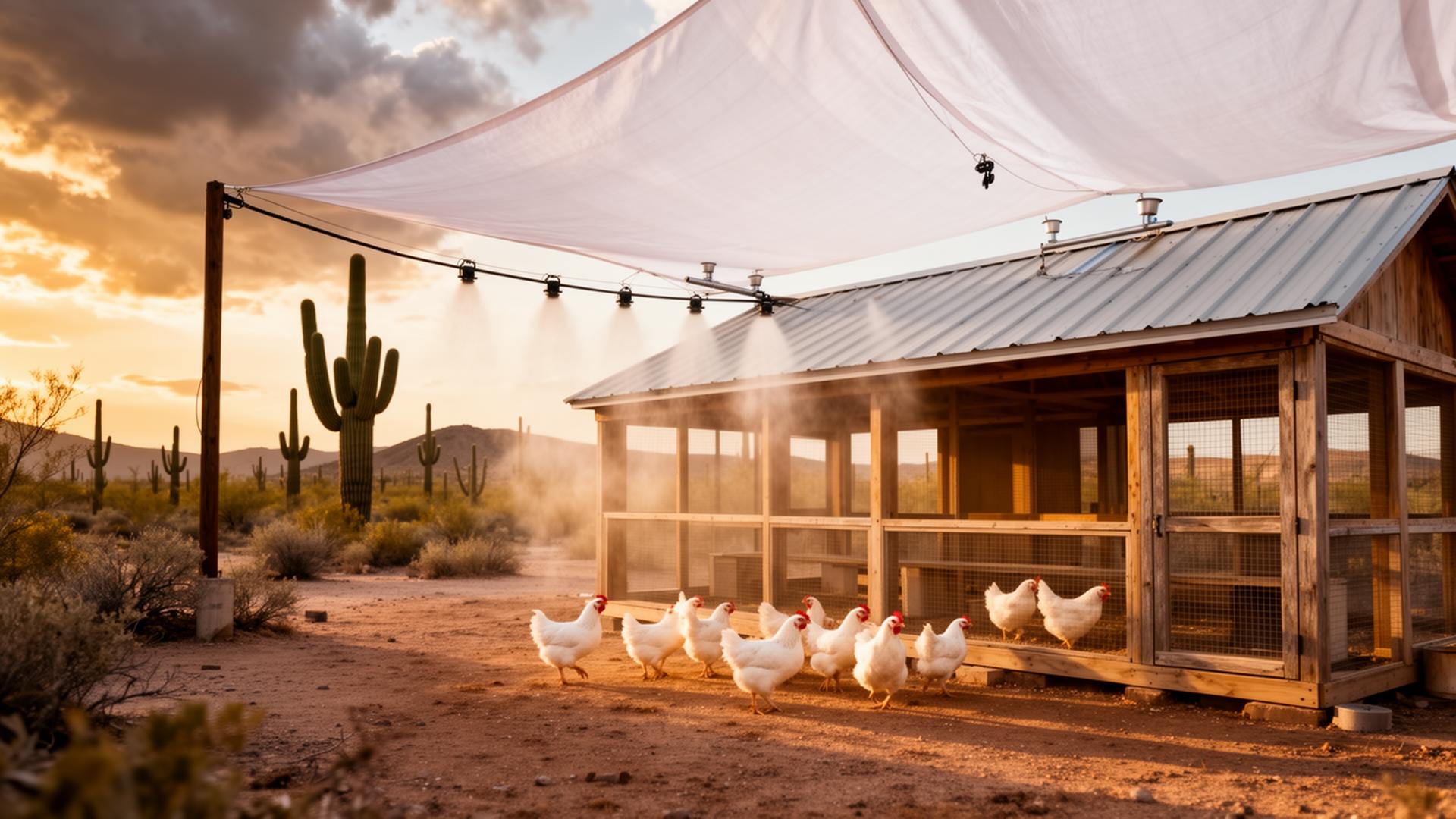
Evaporative cooling works well in Arizona’s low humidity, because dry air has room to absorb water and that phase change is what pulls the heat out. The same misting setup does almost nothing in a humid climate — this is a Southwest-specific tool, not a universal one.
Misting System Specifications
Nozzle size: 0.008” orifice, 10-15 psi pressure
Timer control: 30 sec on, 5 min off at 100°F+
Water use: 2-5 gal/day for 8×12 coop
Installation cost: $80-150 for basic system
Evaporative Cooling Effectiveness
10% humidity
35-40°F reduction
20% humidity
25-30°F reduction
40% humidity
15-20°F reduction
60%+ humidity
Stop misting
Shade Structure Design
Shade is critical, but not all shade is equal in desert conditions. White shade cloth provides better cooling than trees or solid roofs because it allows air circulation while blocking 80-90% of solar radiation.
- Shade cloth density: 80-90% for summer, 70% for winter
- Color: White or aluminized for maximum reflection
- Height: 10-15 feet above coop for air circulation
- Coverage area: 150% of coop footprint (extended shade zones)
Desert-Specific Coop Design Principles
Desert coop design reverses many traditional principles. Where cold-climate coops prioritize insulation and draft prevention, Arizona coops must maximize airflow while providing complete shade.
Arizona Coop Design Rules
- ✓ Ventilation: 2-3 square feet per bird (vs. 1 sq ft elsewhere)
- ✓ Roof height: 8-12 feet (increases hot air volume)
- ✓ Roof material: Light-colored metal with radiant barrier
- ✓ Open sides: 50-70% open (hardware cloth protected)
- ✓ Ground materials: Light-colored gravel or decomposed granite
- ✓ Roosting space: 10-12 inches per bird (vs. 8-10 elsewhere)
Example Coop Sizing for Arizona
4 Birds
8×8 coop minimum
12×16 run
10×12 shade structure
6 Birds
8×12 coop
16×20 run
12×16 shade structure
10 Birds
12×16 coop
20×24 run
16×20 shade structure
Materials That Survive Arizona Conditions
Arizona’s extreme UV radiation, temperature swings of 100°F+, and occasional severe weather destroy standard construction materials rapidly. Choosing the wrong materials costs thousands in premature replacement and can endanger your flock during extreme weather.
Lumber Performance Ranking for Arizona
Excellent Choices (15+ year lifespan)
- Western Red Cedar: Natural oils resist UV and insects, $8-12 per 2×4×8
- Cypress: Excellent moisture resistance, naturally pest-resistant, $6-10 per 2×4×8
- Redwood: Premium choice but expensive, $12-18 per 2×4×8
Good Choices (8-12 year lifespan)
- Pressure-treated pine (ACQ): Cost-effective for non-contact use, $5-7 per 2×4×8
- Douglas Fir (sealed): Strong structural lumber with proper sealing, $4-6 per 2×4×8
Avoid in Arizona
- Untreated pine/fir: Fails within 2-3 years in sun exposure
- Particle board/OSB: Monsoon moisture causes rapid failure
- Composite decking: Extreme heat causes warping and expansion
Water Systems for Desert Chickens
Water management is the most critical aspect of Arizona chicken keeping. In 115°F heat with 10% humidity, chickens can die from dehydration in 6-8 hours. Standard watering systems fail catastrophically in desert conditions.
Arizona Chicken Water Requirements
70-85°F: 0.5-1 pints per bird daily
90-105°F: 1-2 pints per bird daily
110°F+: 2-4 pints per bird daily
Heat stress events: Up to 5-6 pints per bird
Essential Design Principles
- Multiple sources: Minimum 2 independent watering points
- Large capacity: 3-5 gallons per 6 birds minimum
- Shade protection: All waterers must be continuously shaded
- Easy monitoring: Visual water level indicators
Arizona Predator Protection Strategies
Arizona predator pressure is intense and includes species not found elsewhere. Coyotes, javelinas, Gila monsters, and multiple raptor species create challenges requiring specific countermeasures.
Desert-Specific Predator Threats
Coyotes (Most Dangerous)
- Activity: Year-round, peak at dawn/dusk
- Method: Dig under, jump over, or breach fencing
- Defense: 8-foot fencing, buried barriers, electric options
Javelinas
- Activity: Year-round, peak morning/evening
- Method: Break through fencing for feed
- Defense: Heavy-gauge fencing, secure feed storage
Rattlesnakes
- Season: April-October, peak summer
- Attraction: Eggs, chicks, rodents, shade
- Defense: 1/4” hardware cloth, clearing around coop
Harris’s Hawks
- Activity: Year-round, daytime hunting
- Method: Cooperative pack hunting
- Defense: Covered runs, dense shade overhead
Managing Monsoons and Seasonal Changes
Arizona’s monsoon season (June 15 - September 30) brings sudden weather changes: humidity spikes from 10% to 70%, temperature drops of 20-30°F during storms, intense rainfall (1-2 inches in 30 minutes), flash flooding, and frequent lightning.
Year-Round Management Calendar
Jan-Feb: Mild Winter
- • Best weather for coop maintenance
- • Plan and order materials
- • Repair winter storm damage
Mar-Apr: Spring Prep
- • Begin heat system preparation
- • Deep clean coops
- • Install/service cooling systems
May-Jun: Pre-Summer
- • Complete all projects before extreme heat
- • Test cooling systems thoroughly
- • Prepare for monsoon season
Jul-Sep: Survival Mode
- • Focus on maintaining life-support systems
- • Monitor birds continuously
- • Avoid major construction projects
Best Chicken Breeds for Arizona
Breed selection can make the difference between thriving chickens and constant struggle in Arizona’s extreme climate. Heat-tolerant breeds share specific physiological characteristics that help them survive 115°F+ temperatures.
Excellent Arizona Breeds
White Leghorn (Top Choice)
- Heat tolerance: Excellent, Mediterranean origin
- Eggs: 280-320 large white eggs annually
- Size: 4-5 lbs, efficient feed conversion
- Cost: $15-25 per chick
Egyptian Fayoumi
- Heat tolerance: Extreme, North African desert origin
- Eggs: 150-200 small eggs, consistent in heat
- Hardiness: Disease resistant, very long-lived
- Cost: $25-40 per chick (rare, worth seeking)
Breeds to Avoid in Arizona
Cold-climate breeds that struggle in desert heat:
- Brahma: Massive size, dense feathering—can die within hours at 110°F+
- Cochin: Extreme feathering, nearly impossible to manage in AZ summers
- Buff Orpington: Dense feathering, heat-absorbing color, high mortality risk
Troubleshooting Common Arizona Problems
Emergency Heat Response Protocol
When birds show severe heat stress (panting, wings spread, lethargic)
- 1. Move immediately to coolest available location
- 2. Cool water immersion: Feet and legs in lukewarm (not cold) water
- 3. Increase airflow: Fans, misting, whatever is available
- 4. Offer electrolyte water: Encourage drinking
- 5. Monitor recovery: Birds should respond within 30-60 minutes
- 6. Seek vet care if no improvement after 1 hour
Water System Failure Response
- Immediate: Any clean water in any container
- Short-term: Multiple shallow dishes refreshed frequently
- Cooling addition: Add ice to water (not directly to birds)
- System repair: Fix primary system or install temporary backup
Conclusion: Your Success in the Arizona Desert
Successful chicken keeping in Arizona requires abandoning conventional wisdom and embracing desert-specific strategies. The extreme heat, intense UV radiation, unique predators, and dramatic weather changes demand approaches that would seem excessive in moderate climates but are essential for survival here.
Your path to success starts with these priorities:
- 1. Understand local regulations - Know your city requirements and HOA restrictions before starting
- 2. Invest in heat management - Shade, ventilation, and cooling systems aren’t optional luxuries
- 3. Choose appropriate breeds - Mediterranean breeds will thrive while cold-climate breeds will struggle or die
- 4. Plan for extreme weather - Both summer heat and monsoon storms require specific preparation
- 5. Connect with local resources - Arizona suppliers and communities understand desert challenges
Thousands of Arizona chicken keepers are succeeding with these methods. With proper planning, appropriate materials, and desert-adapted management, you can maintain a thriving, productive flock year-round in the Sonoran Desert. The key is respecting the environment and working with it, not against it.
Related Plans
The walk-in shed coops handle Arizona heat best — tall enough for real cross-ventilation and roomy enough that birds aren’t packed together radiating heat at each other. The 6x10 walk-in shed coop fits a mid-size desert flock, and the 10x10 and 10x12 walk-in shed coops scale up for anyone running 15-plus hens through a Phoenix summer. For the biggest flocks, the 8x16 walk-in shed coop adds a feed room without sacrificing the vent area a desert build needs.