Building
Material choices checked against published span tables, with 2026 pricing
Building a Chicken Coop Plans | Every plan’s material list is computed from its own geometry
September 2026
16 min read
For a worked example, the 8×8 coop plan lists 104 2×4s, 10 sheets of 3/4-inch plywood and 10 metal roofing panels — the complete bill of materials is published on the page, free.
Quick Overview
Difficulty
All Levels
Content Type
Materials Guide
Coop shell budget
$15-$65 per sq ft
Checks run per plan
2,600+ deterministic
The right material choices save you a rebuild, and the wrong ones cost more than the savings. This guide covers what we specify across the whole plan line, why each spec is there, and what it costs in 2026.
Where a number comes from a published table or an extension service, we name the source. Where it’s our own design decision, we say so. That distinction matters more in coop building than in almost any other DIY category, because most of the advice online is repeated rather than sourced.
Material Categories & Budget Overview
Materials fall into rough budget tiers, each trading upfront cost against lifespan. Understanding the tiers prevents the common mistake of mixing incompatible quality levels.
Budget tiers for a coop shell (4x4 example)
- Budget build ($250-$400): basic protection, shortest service life
- Standard build ($400-$650): good durability, the tier most people should target
- Premium build ($650-$1,000): cedar or redwood siding, better hardware
- Full plan build ($1,650-$2,150): what our 4×4 starter coop actually computes
That last line is the one worth pausing on. A shell price and a complete build price aren’t the same number, and most published coop budgets quietly quote the first while implying the second.
Our plan totals include the attached run, the pier foundation and gravel, every foot of hardware cloth with a buried apron, all fasteners by count, the run floor material, and primer plus paint. Nothing in them is a rounded guess — each figure is computed from that design’s own geometry at 2026 prices, with no waste allowance added.
The “weak link” principle
Your coop is only as durable as its cheapest component. Pairing $300 of cedar with $15 of chicken wire gets you a beautiful coop and dead birds. Every choice should line up with your durability target.
- Premium lumber plus cheap mesh: the mesh decides the outcome
- Quality frame plus bargain roofing: the structure rots from the top down
- Expensive automation plus basic construction: electronics fail as the frame shifts
Regional considerations
Climate changes which materials survive and which specs bind.
Desert Southwest
- UV degrades exposed plastics and unpainted trim fastest here
- Heat expansion works fasteners loose — use screws, not nails, on metal
- Monsoon runoff means drainage and deep overhangs earn their cost
Humid Southeast
- Rot and termite pressure push you toward cedar or PT near grade
- Cross-ventilation matters more than any wall assembly
- Hardwood is cheap and locally available
Cold Northern States
- Freeze-thaw cycles split anything holding water
- Snow load is the real spec: IRC rafter tables step at 30, 50 and 70 psf ground snow
- A 2x4 rafter at 24-inch centres spans 6’-9” at 30 psf and 5’-6” at 50 psf — heavy-snow country needs 2x6
Lumber Guide: What Lasts vs. What Fails
Lumber is 40-60% of your material cost and sets the structure for decades. Two rules cover most of the decisions.
Pressure-treated lumber
Use it for ground contact only. Skids, buried posts, bottom plates, and hidden framing near grade. That’s our recommendation, and it’s about contact rather than danger.
Modern pressure treatment uses ACQ or copper azole. It has contained no arsenic since the residential CCA phase-out completed on 31 December 2003, per the EPA. It’s safe for what we use it for.
Still, keep it out of roost bars, nest boxes and interior surfaces birds peck directly. If you’re making organic claims, check against the National Organic Program first — the EPA advises against treated wood in organic production contexts.
2026 price: $6.50-$8.50 per 2x4x8.
Untreated lumber options
| Species | 2026 price per 2x4x8 | Rot resistance | Best use |
|---|---|---|---|
| Construction-grade pine / fir / SPF | $4.50-$6.00 | None untreated | Framing, roosts, nest boxes, anything under cover |
| Western red cedar | $18-$28 | High, natural | Siding, trim, premium builds |
| Redwood (where available) | $22-$35 | High, natural | Premium builds, coastal regions |
The cedar distinction is worth stating clearly. Cedar lumber is fine and actually preferred for rot resistance. Cedar shavings are the respiratory concern, because of plicatic acid at bedding-level surface area and exposure.
Never let “avoid cedar” as bedding advice turn into “avoid cedar lumber”. They’re different problems separated by orders of magnitude.
The rule that saves the most rebuilds: anything within an inch of the ground is pressure-treated or cedar. Untreated pine bottom plates sitting on damp ground are the single most common structural failure in a homemade coop, and they take the siding with them.
If free material is the point, our 6×8 pallet-clad coop frames in real lumber and clads in reclaimed pallet board. It’s honest about the tradeoff: about a fifth of every 40-inch deck board goes in the bin, because butt joints in horizontal cladding have to land on a stud centre.
Shopping tips that actually move the number
- Buy PT only for ground contact. Everything above the foundation can be cheaper stock.
- Check construction salvage for cedar and redwood at a fraction of retail.
- Buy standard 8-foot lengths. They cost less per foot than 10s or 12s.
- Ask for project pricing. Lumber yards discount whole-build orders.
- Reject warped, split or heavily knotted boards at the yard, not at home.
Roofing: Materials, Pitch and Overhangs
The roof decides whether the framing below it lasts. Leaks rot rafters, condensation drips on roosting birds, and a summer roof with no overhang bakes the walls.
Roof styles
Shed roof (single slope). One plane, no ridge framing, water goes one direction. It’s the easiest roof a first-time builder can frame, and it has a structural bonus: a single plane has no opposing rafter pairs, so there’s no outward thrust to tie against. Our 4×8 lean-to coop and the 8×12 walk-in shed coop both use it.
Gable roof. Two planes meeting at a ridge. More headroom, natural peak ventilation, and it sheds in both directions — see the 6×8 A-frame coop. It costs you a ridge board and a rafter tie on every opposing pair, and that tie isn’t optional. A pitched roof pushes outward at the eaves, and untied rafters spread the walls progressively. IRC R802.3 gives you two legal options: tie every pair, or design a ridge beam.
Saltbox. An asymmetric gable, long slope at the back and a short steep slope at the front. You get a tall front wall for the door and egg access, and a low back wall that uses less material and fights wind better.
Roof pitch minimums
Pitch is rise over run — 4:12 means four inches of rise per twelve of horizontal run. These minimums come from the coverings themselves, not from preference.
| Covering | Minimum pitch | Notes |
|---|---|---|
| Asphalt shingle | 4:12 | 2:12 allowed with doubled underlayment |
| Metal, exposed fastener | 3:12 | The floor for corrugated panels |
| Metal, standing seam | 0.5:12 | Rarely worth it at coop scale |
| Polycarbonate | ~1:12 | Use for 30-50% of roof area at most |
Our shed-roof coops sit at 3:12, right at the exposed-fastener minimum, and the A-frames run far steeper so snow leaves on its own. In heavy-snow country pitch matters less than rafter size — check the span numbers before you pick a look.
Material comparison
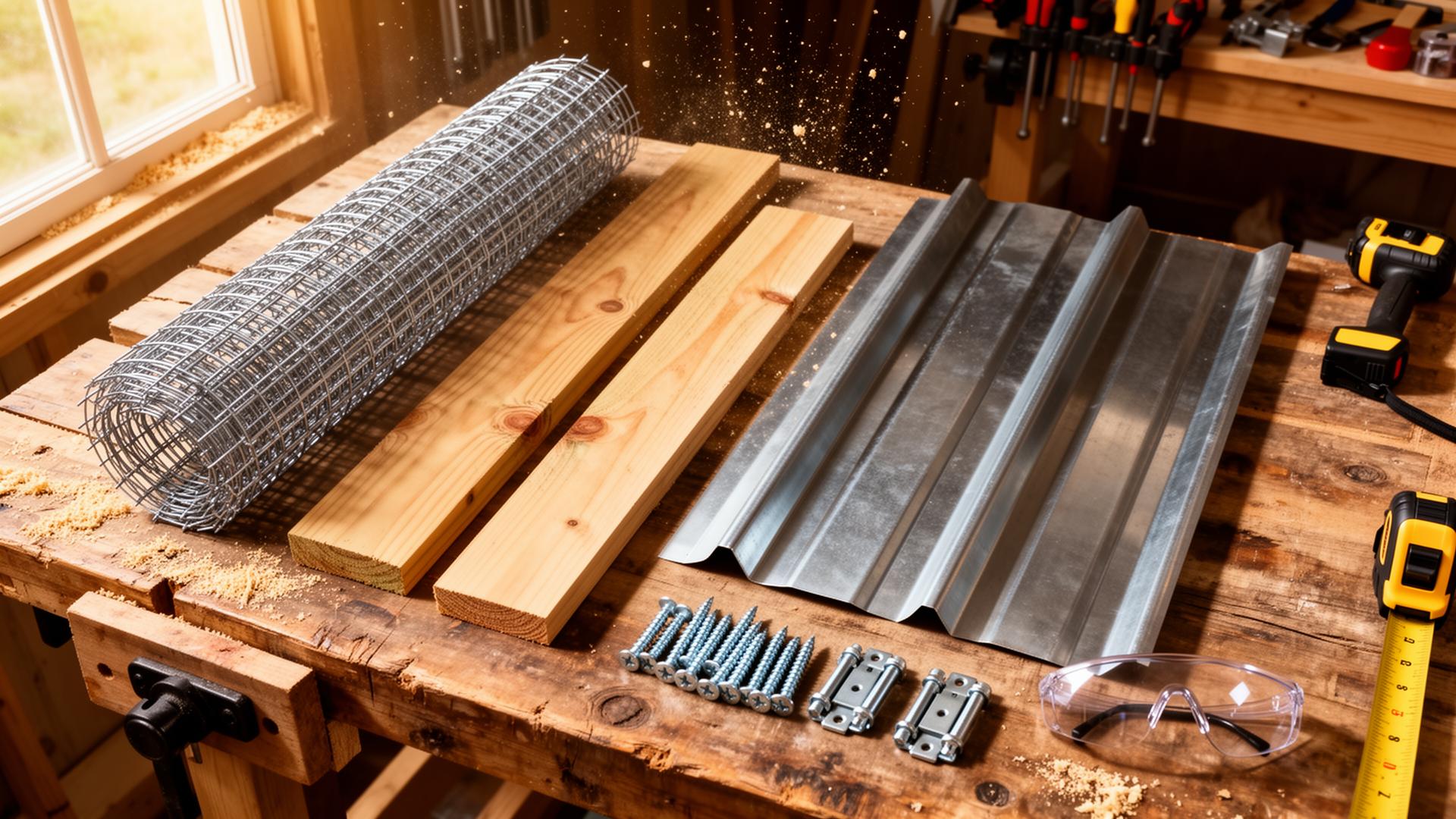
Corrugated galvanized metal is what we specify on every plan. $2.50-$4.00 per sq ft, decades of service, no tear-off, sheds snow, and it can screw straight to purlins with no sheathing. Use rubber-gasketed screws on the ridges of the corrugation and lap panels one full corrugation.
Asphalt shingles run $1.50-$2.50 per sq ft for 3-tab and $2.50-$4.00 for architectural. They’re quieter, familiar to install, and they always need continuous plywood beneath. Add the sheathing cost before comparing them to metal.
Cedar shingles at $8-$15 per sq ft are an aesthetic choice on a premium build, not a value one.
Polycarbonate at $2.50-$5.00 per sq ft brings daylight in, which is genuinely useful over a run. It overheats and yellows, so cap it at a third to half the roof area and pair it with metal.
What a coop roof costs
Roofing is typically 15-25% of a build. For a standard 4×8 coop:
| Covering | Materials cost | Includes |
|---|---|---|
| Corrugated metal | $60-$120 | Panels, screws, ridge cap |
| Asphalt shingles | $80-$160 | Shingles, plywood, underlayment, nails |
| Polycarbonate | $100-$200 | Panels, closure strips, screws |
| Rolled roofing | $20-$60 | Roll, plywood, cement, nails |
Overhangs and roof mistakes
- Six inches minimum on all sides; 12 inches for temperate climates
- 18-24 inches where rain splashes back onto siding
- 24-36 inches in desert heat, where the overhang is shading the wall
- Drip edge on every edge before the covering goes down
- Rubber-gasketed screws on metal, roofing nails on shingles — never mix
- Work bottom-up so water always runs over a lap, never under it
Overhangs also protect the high vents you’re relying on for airflow. A vent slot cut into siding with nothing above it runs water down the inside of the wall.
Ventilation belongs in the roof
Hot, wet air rises, so the highest point in the building is where you take it out. Ridge vents run a continuous gap at the peak covered with hardware cloth. Soffit vents under the overhang draw fresh air in. Gable vents work the triangular wall section on a gable roof.
For sizing and placement, see the ventilation guide. One caution on mesh: IRC R806.1 caps roof vent openings at 1/4 inch, and 1/4-inch hardware cloth is also the size the weasel forces. That’s the rare case where the coarsest legal option and the finest predator-driven one are the same product.
Hardware Cloth: The One Spec Not to Economise On
This is the most consequential material on the list. Get it wrong and the rest doesn’t matter.
The specification we use
1/4-inch, 19-gauge galvanized hardware cloth, screwed through fender washers rather than stapled alone.
Why 1/4 inch and not 1/2 inch: a least weasel squeezes through a half-inch opening, per University of Kentucky Extension ID-245. Half-inch mesh genuinely stops raccoons, and if that’s all you use you can’t claim weasel, mink or snake exclusion. Quarter-inch is the single threshold that covers small predators without pretending to a species-by-species precision the literature doesn’t support.
Why chicken wire fails, in ID-245’s own terms: a raccoon that can’t get in will reach through the wires and eat what it can reach. The predator never has to enter. Aperture size is the binding constraint, not the strength of the perimeter.
On gauge: 19-gauge is our recommendation, not a verified standard. The widely repeated claim that 19-gauge stops raccoons while 23-gauge doesn’t appears in no extension, USDA or wildlife-agency document. The physical logic is sound — 19-gauge is 0.0359” against 23-gauge at 0.0226” — but treat it as practitioner consensus.
2026 price: $85-$120 per 48” x 100’ roll, roughly $0.30-$0.40 per square foot.
Installation is half the spec
Perfect mesh installed badly fails like cheap mesh.
- Fasten with screws and fender washers. Raccoons pry at edges, and staples back out under sustained perpendicular pull. Fastener spacing is our judgement call, not a published figure.
- Bury an apron 12 inches, down and out, around the whole run perimeter. Three extension services land on that number independently: Kentucky ID-245 says at least 12 inches, Maryland says 12 to 18, and UF/IFAS says up to 2 feet. Go 18-24 inches under persistent diggers.
- Overlap seams by an inch minimum.
- Screw into solid framing, never into thin trim.
- Cover the windows too. An open window is a hole a raccoon walks through, and it’s the ventilation you depend on in summer, so it has to stay open at night.
Foundation Materials
Foundation choice sets longevity, predator resistance and, in many jurisdictions, whether the structure is even classified as permanent.
Skid foundation
Pressure-treated 4x6 skids on solid concrete deck blocks over compacted gravel. Around $80-$150 for a 4x8 coop: $45-$65 for the skids, $18-$30 for blocks, $15-$25 for gravel.
It’s moveable, drains well, and usually stays under the permit threshold. It gives moderate predator protection and it isn’t storm-anchored.
Concrete pad
A 4-inch reinforced slab runs $6-$12 per square foot installed. It’s the maximum predator barrier, permanent, and easy to clean. It also triggers permits in many areas, drains nowhere, and stays cold.
Best reserved for large coops under serious predator pressure.
Raised platform
Post-and-beam on piers, $4-$8 per square foot. It’s the best predator deterrent of the three, and the space underneath becomes shade the flock uses all summer.
Height is the spec that matters here. Colorado State Extension recommends raising a coop about a foot off the ground to discourage rats, skunks and snakes. Go 18 inches or more where rats are a known problem. Our raised floors run 18-24 inches, which clears both tiers.
Use galvanized or stainless post anchors at the post-to-footing connection. Frost depth is set locally, never nationally — IRC R403.1.4.1 hands it to your jurisdiction with 12 inches below grade as the absolute floor. Confirm your number with the county before you dig.
Fasteners & Hardware
Fastener failure causes more coop problems than any other single issue.
| Application | Fastener | Size | 2026 cost per pound |
|---|---|---|---|
| Structural framing | Galvanized deck screws | 3” for 2x4 joints | $8-$12 |
| Sheathing and siding | Galvanized wood screws | 1-1/4” to 1-1/2” | $6-$10 |
| Metal roofing | Self-drilling, neoprene washer | 1” to 1-1/2” | $12-$18 |
| Hardware cloth | Screws with 1” fender washers | 1” | $15-$25 |
Screws over nails almost everywhere. They hold under the vibration and thermal cycling that works nails loose, and they come back out when you need to modify something.
Latches and hinges
Use a two-action latch on every people-door and every nest-bank lid. That’s a sensible precaution and it’s our recommendation — the popular explanation involving raccoon thumb mechanics traces to no extension, USDA or wildlife-agency source, so don’t rely on it as a proven mechanism.
| Latch type | Cost each | Verdict |
|---|---|---|
| Spring-loaded bolt with carabiner | $12-$18 | Our default on doors |
| Eye-and-eye turnbuckle | $8-$15 | Good, slow to operate |
| Simple slide bolt | $3-$8 | Not on its own |
| Hook and eye | $2-$5 | No |
Buy hinges in pairs and count them off your openings rather than guessing. Any plywood door over 30 inches tall wants a diagonal brace, and the diagonal has to run up from the hinge corner. Reversed, it carries nothing and the door sags within a season.
Insulation & Ventilation Materials
Ventilation prevents more health problems than any other single factor. Insulation is conditional, and most coops are better off without it.
Ventilation materials
- 1/4” hardware cloth over every opening, for the reasons above
- Adjustable louvers: $15-$30 each
- Drip cap flashing over any vent slot cut into siding, $10-$20 per 10-foot length
Sizing the vents
We size permanent vents at 1 square foot of opening per 10 square feet of floor. That’s our own design default, not a published standard — the ratio quoted all over the internet traces to no verifiable source, and we tier it honestly rather than dress it up.
What the authorities actually publish is an air-quality outcome. Certified Humane sets ammonia at or below 10 ppm at bird height for layers. Ammonia damages respiratory tissue from around 5 ppm, and people can’t smell it until roughly 20 ppm — so a coop that smells is already past the line.
Put vents above roost height, increase the area in hot climates, and never close them for winter.
Insulation
Most coops don’t need it. Insulating a coop without adding ventilation makes moisture worse, not better, and the University of Kentucky is clear that insulation’s real job is keeping interior surfaces above the dew point rather than trapping warm air.
If you do insulate, budget for the layers nobody expects. Our 8×12 insulated coop costs $5,500-$7,100 against $4,250-$5,450 for the same building uninsulated. That $1,250-$1,650 difference is OSB sheathing, house wrap, 365 sq ft of batt, 12 sheets of plywood liner, baffles, flashing and weatherstrip — not just the batt.
Full detail, including what R-13 actually delivers in a stud wall, is in the insulation guide.
What We Specify Across Every Plan
These are the line-item choices the whole plan set shares, and the reason for each.
| Component | Our spec | Why |
|---|---|---|
| Floor joists | 2x6 at 16” OC | No published span table lists a 2x4 floor joist at any span |
| Girders | Doubled 2x6 minimum | The smallest beam AWC DCA6 Table 3A tabulates |
| Rafters | 2x4, sized against snow load | Adequate at 30 psf; 2x6 above that on wide spans |
| Headers | Doubled, depth sized by span | IRC Table R602.7(1), not a fixed 2x4 |
| Wall studs | 2x4 at 16” OC, doubled top plates | 16” puts 4x8 sheet seams on framing; IRC R602.3.2 |
| Roof | Corrugated metal on 3/4” plywood | Sheds snow, no tear-off, stiffens the building |
| Mesh | 1/4” 19-gauge, 12” buried apron | Univ. of Kentucky ID-245 |
| Posts | 4x4 on pier blocks, galvanized anchors | DCA6’s 6x6 table is scaled for decks, not coops |
| Ground contact | PT or cedar only | Everything above grade can be cheaper stock |
Every plan is checked against these before it’s published, and the generator blocks export if any check fails. It runs more than 2,600 of them per release.
One thing we don’t claim: these plans are framed to published AWC and IRC span tables, which is not the same as a stamped engineering analysis. Prescriptive tables are conservative by design. A stamped analysis needs a licensed engineer’s seal, and we won’t imply we have one.
Where to Buy
Sourcing well cuts 20-40% off a material bill without changing a single spec.
Farm supply stores — Tractor Supply, Rural King, local co-ops — are usually the cheapest source of hardware cloth and bulk fasteners, and they stock the 1/4-inch mesh the big boxes often don’t.
Local steel and metal suppliers beat home-centre pricing on roofing panels by a wide margin, especially if you can take standard lengths. Mobile-home suppliers and commercial roofers sell offcuts.
Independent lumber yards quote project pricing on a whole build and grade better than a home centre’s bunk. Sawmills sell cedar direct. Construction salvage is where cedar and redwood get cheap.
Home centres are the convenience option and the price ceiling. They’re the right call for a handful of boards, not for 87 of them.
Buy late fall or early winter if you can wait. Lumber pricing softens after building season.
Complete Budget Build Lists
These are coop-shell material lists, not complete builds. Add the run, foundation, mesh and finish for a full project cost.
Budget build: 4x4 starter shell
| Item | Qty | Unit | Total |
|---|---|---|---|
| PT 2x4x8 (bottom plates and skids) | 2 | $7.50 | $15 |
| Pine 2x4x8 framing | 8 | $5.25 | $42 |
| OSB sheathing 1/2” | 3 sheets | $22 | $66 |
| 3-tab shingles | 1 bundle | $35 | $35 |
| 1/4” 19-ga hardware cloth | 25 sq ft | $1.60/sf | $40 |
| Hinges and latches | set | $25 | $25 |
| Fasteners and misc | — | $35 | $35 |
| Total | $258 |
Standard build: 4x6 shell
| Item | Qty | Unit | Total |
|---|---|---|---|
| PT 4x6x8 skids | 2 | $28 | $56 |
| PT 2x4x8 plates | 12 | $7.50 | $90 |
| Plywood sheathing 1/2” | 4 sheets | $35 | $140 |
| Corrugated metal roofing | 35 sq ft | $3.20/sf | $112 |
| 1/4” 19-ga hardware cloth | 40 sq ft | $1.60/sf | $64 |
| Quality latches and hinges | set | $45 | $45 |
| Galvanized fasteners | complete | $65 | $65 |
| Total | $572 |
Compare those to a full plan build and the gap is the run, the foundation, the buried apron and the paint. Our 4×4 starter coop computes $1,650-$2,150 complete, and every line of that is published on the plan page.
Build Once
Material quality should be consistent across every component. Budget lumber with premium hardware, or expensive automation on basic construction, creates the weak point that decides how long the whole thing lasts.
Spend where failure is expensive: hardware cloth, ground contact, and the roof. Save where it isn’t: framing stock above grade, interior surfaces, and anything you can replace with a screwdriver.