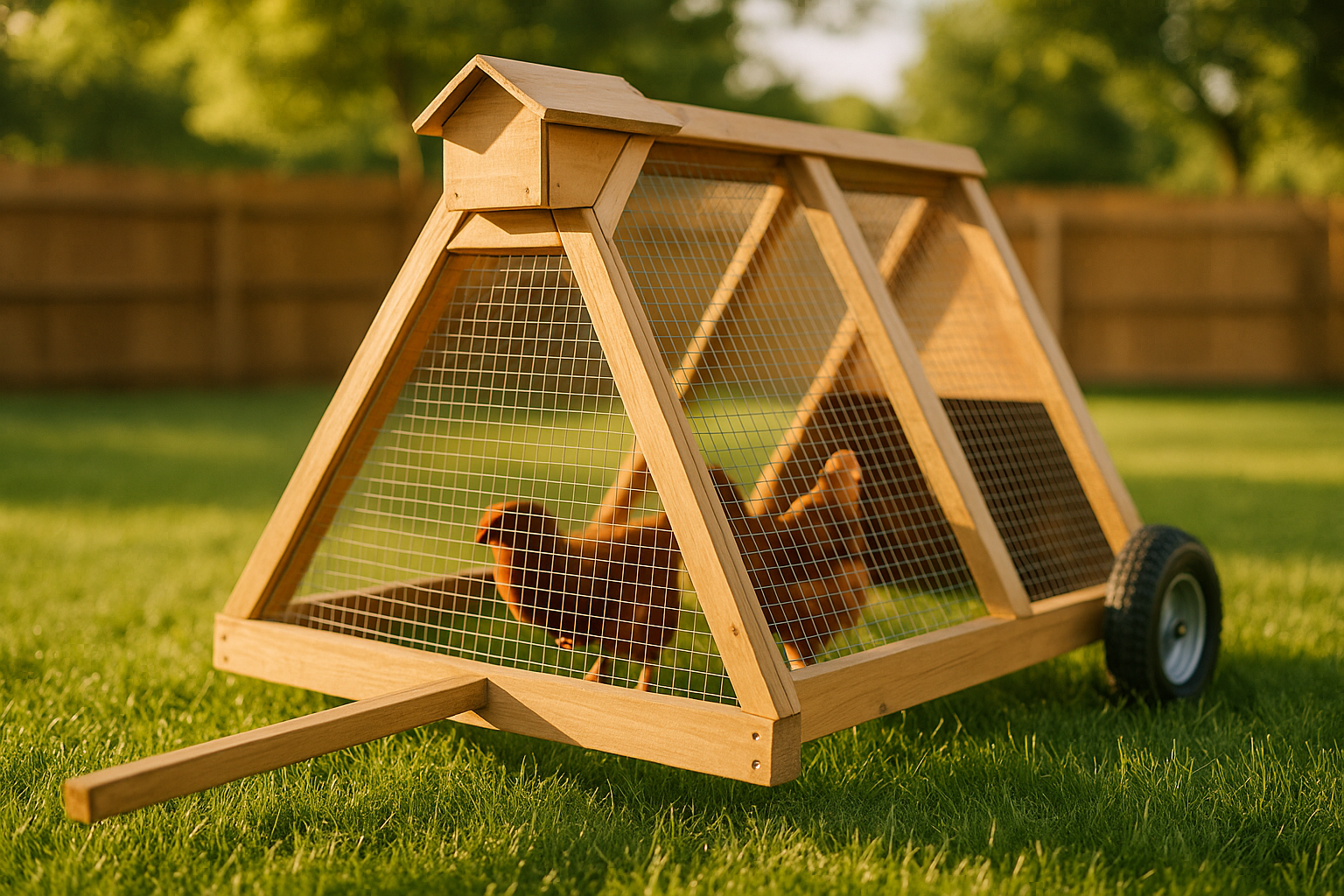
A chicken tractor turns lawn into eggs and skips the foundation. You move it a few feet each morning, the birds get fresh grass and bugs, and the old spot gets fertilized. No concrete, no permanent footprint, and nothing for a predator to stake out.
This guide covers the three movable designs we publish, plus a fourth on skids for people who’d rather move seasonally. It also covers the mobility mechanics that decide whether the system survives a rainy Tuesday.
Why our numbers look different
Every cost and dimension on this page comes from the bill of materials each design actually computes, at 2026 prices, with no waste allowance. That’s why our tractors cost more than the $120 builds you’ll find elsewhere. Those budgets count lumber and stop; ours counts the hardware cloth, wheels, axle, roll roofing, earth anchors, fasteners and paint.
The framing is sized against published span tables from the American Wood Council and the IRC, with headers sized by span. The generator runs over 2,600 deterministic checks on each design and refuses to export a plan that fails one. Nathan designed and built the 8x8 coop the flagship plan set came from.
One thing we won’t claim: no professional engineer has stamped these plans. They’re framed to published span tables, which is a real standard and a different one.
What makes a tractor different from a coop
Moving it daily drives every design choice:
- Open ground at the run end. The birds scratch directly on grass. The rails sit flush so nothing crawls under.
- Light where it counts. Wheels on pivoting arms mean you carry a fraction of the weight, not all of it.
- Short and wide, not tall and narrow. Lower center of gravity, less wind to catch.
- Few features. No feed room, no electricity, no deep storage. Portability costs you everything else.
The tradeoff is honest: a tractor is a three-season system in most climates, and it’s less secure than a fixed coop with a buried apron. Most tractor keepers own both.
The four designs we publish
1. 4x8 A-frame tractor — the one to start with
Two sloped walls meeting at a ridge, so the roof is the wall. Fewer cuts than any other style, and the triangle is rigid before you sheathe it.
- Holds: 2-3 hens
- Space: 32 sq ft footprint, 26 sq ft usable (10 sq ft enclosed roost end, 16 sq ft run end)
- Build time: 14-20 hours
- Materials cost: $675-$875
- Move gear: 8-inch sealed-bearing lawnmower wheels on pivoting arms with drop pins
- Mesh: 1/4-inch 19-gauge hardware cloth throughout
Note the gap between 32 sq ft of footprint and 26 sq ft you can use. Sloped walls eat floor, which is the A-frame’s real cost and the number most plans quietly skip.
See the 4x8 A-frame tractor plans — full specs and cut tables free on the page, plus a free preview PDF.
2. 6x10 A-frame tractor — same shape, real flock
The 4x8 tops out at three hens. If you want five or six on pasture, this is the same geometry stretched.
- Holds: 4-6 hens
- Space: 60 sq ft footprint, 52 sq ft usable
- Build time: 22-30 hours
- Materials cost: $800-$1,025
- Move gear: 10-inch pneumatic wheels, 78-inch steel axle
- Mesh: 1/4-inch 19-gauge hardware cloth
Pneumatic wheels aren’t a luxury here. Hard rubber rolls fine on a patio and bogs down on the wet lawn where chickens actually live.
See the 6x10 A-frame tractor plans.
3. 4x10 cattle-panel hoop — fastest build, honest limits
Three arches cut from two galvanized cattle panels, over a wooden base, with a tarped closed end. It’s the quickest weekend build in the line.
- Holds: 2-4 hens
- Space: 40 sq ft footprint, 34 sq ft usable
- Build time: 12-16 hours
- Materials cost: $1,000-$1,300
- Mesh: 1/2-inch 19-gauge hardware cloth over the arch
Two honest caveats. The panels alone weigh about 44 lbs each, so the “cheap and light” hoop reputation doesn’t survive a real bill of materials. And 1/2-inch mesh stops raccoons but not weasels, mink or snakes, so we don’t claim small-predator exclusion on this one.
We don’t publish a PVC hoop. PVC goes brittle under UV within a few seasons, and we’d rather not sell you a coop with an expiry date.
See the 4x10 hoop tractor plans.
4. 6x8 A-frame coop on skids — move it seasonally, not daily
If the daily move isn’t happening, stop pretending. This is the A-frame on pressure-treated skids over concrete blocks, with a buried hardware-cloth apron and rebar ground anchors.
- Holds: 3-5 hens
- Space: 48 sq ft footprint, 41 sq ft usable
- Build time: 20-28 hours
- Materials cost: $975-$1,275
- Mesh: 1/4-inch 19-gauge hardware cloth, plus a staked apron leg
You drag it with a tractor or ATV a few times a year. In exchange you get the dig protection a true tractor can’t have, because a buried apron and daily moves are mutually exclusive.
See the 6x8 A-frame coop plans.
Mobility is a system, not a wheel
This is where most mobile coop plans fall apart. A tractor can be roomy, dry and well-ventilated, and still fail because moving it is miserable.
Wheel placement. Put the heavy end near the axle. When you lift the handles you should feel a fraction of the total weight, not half of it. Bigger diameter rolls over ruts that stop a small wheel dead.
Wheels, skids or both. Wheels for hand moves. Skids for towing, at the cost of turf. A hybrid carries the frame on skids at rest and lifts it onto wheels for the move, which is why our A-frame tractors pin their arms up and down.
Tow geometry. A tow point set too high or too low twists the frame every time you pull. Keep the force on structural members and use a V-shaped bar to stop the racking.
The bottom edge. Uneven ground opens gaps where birds walk out and predators walk in. A flexible skirt or a smooth lower rail conforms better than a stiff square edge. Stake the corners at night in predator country.
The test that matters: if you can’t move it in three to five minutes, you won’t do it in bad weather.
Matching the build to your predator pressure
Protection fights mobility. The trick is layering it where it counts instead of building a tank you can’t lift.
Low pressure — suburban yard, mostly loose dogs. A light tractor works if the bottom edge sits flush.
Medium pressure — raccoons, foxes, the occasional stray. Use 1/4-inch hardware cloth everywhere, two-action latches, and lock the roost end at dusk.
High pressure — coyotes, regular visits. Pair the tractor with electric poultry net, or move to the skid-mounted coop with a buried apron.
Forgetting to shut the door at dusk is the most commonly cited cause of predator loss. That’s a human-error problem, not a hardware problem. Our predator-proof coop guide covers the mesh, latch and apron specs, and predator identification helps you read the evidence after a loss.
Any plan that says “predator-proof” without describing edge gaps, latches and nighttime security is selling you a word.
The daily move
Morning, five minutes:
- Pin the wheel arms down so the wheels take the load
- Walk it four to six feet to the next spot, same orientation
- Set it down and pin the arms back up
- Check the bottom rails sit flush — no gaps
- Top up water
Evening, two minutes:
- Confirm the birds went up to the roost end at dusk
- Latch it
- Walk the perimeter and look for fresh digging
The system fails one skipped day at a time. After three or four days on one spot you get a manure-burned dead patch. The birds fight over what’s left, and the fox down the road learns your schedule.
Rotation patterns that work
The grid. Mark 10-12 tractor-sized spots in rows. Move down one row and back up the next, so each spot rests 10-12 days. Works on a quarter acre and up.
The garden zone. After harvest, run the tractor down the vegetable rows for a month. The birds eat hornworms, scratch out weed seeds and fertilize for spring.
The mown lawn. Plan the route so every spot gets hit once a month through the growing season.
What the birds do to your soil
Done right, rotation spreads manure evenly, breaks up thatch, interrupts pest cycles and pushes plant diversity. Done wrong, it strips the ground bare.
Three ways it goes wrong: too long in a wet season, too many birds per square foot, or coming back before the ground recovered. The fixes are the same three levers in reverse — shorter stays, fewer birds, longer rest.
Six mistakes that kill tractor builds
1. Building too heavy. A tractor you can’t move alone is a tractor that doesn’t get moved.
2. Chicken wire. A raccoon reaches through the mesh and takes what it can reach, without ever getting inside (University of Kentucky Extension ID-245). Aperture size is the constraint, not perimeter strength. Use 1/4-inch hardware cloth.
3. No locking roost compartment. An open-bottomed tractor needs one secure box the birds sleep in and you latch at dusk.
4. Building too tall. Over about four feet at the peak, the whole thing catches wind like a sail. You’ll stoop to clean, and that’s the deal.
5. Forgetting drainage. Rain runs off the roof onto the perimeter the birds are standing on. Pitch it and run a drip edge so the water sheds outside the footprint.
6. Hard plastic wheels. They work on concrete and nowhere else.
When a tractor is the wrong answer
Be honest before you buy lumber:
- You travel. Daily moves need you, or a sitter, home every day.
- You get real winters. Three-season system in most climates.
- Your yard is under 1,500 sq ft of usable lawn. You’ll burn through rotation spots in a week.
- You want maximum eggs from few birds. Fixed coops with settled nesting beat tractors on production.
- You won’t commit to the move. It’s five minutes, every single day.
If that’s you, build a fixed coop with a run. The 4x4 starter coop suits 2-3 hens and the 6x8 coop with run handles 6-9. Our chicken run design guide covers sizing the outdoor half properly.
The strongest setup: both
Most experienced flocks end up running a small permanent coop plus a tractor.
The permanent coop covers overnight security, winter, sick birds and storms. The tractor covers spring through fall on grass. Birds learn to come back to the permanent coop at dusk either way.
Use the coop size calculator to size the permanent half, then pick the tractor that fits your rotation. For climate-specific changes to ventilation and shade, see the climate coop guide.
Next steps
- 4x8 A-Frame Chicken Tractor — 2-3 hens, $675-$875
- 6x10 A-Frame Chicken Tractor — 4-6 hens, $800-$1,025
- 4x10 Cattle-Panel Hoop Tractor — 2-4 hens, fastest build
- 6x8 A-Frame Coop on Skids — 3-5 hens, seasonal moves with a buried apron
- How to Build a Chicken Coop — the framing sequence, start to finish
- Coop Materials Guide — lumber, mesh and fastener specs
Every plan page publishes its dimensioned drawings, full material list and per-step cut tables free, along with a free preview PDF. The complete step-by-step book is $4.99 on Etsy.