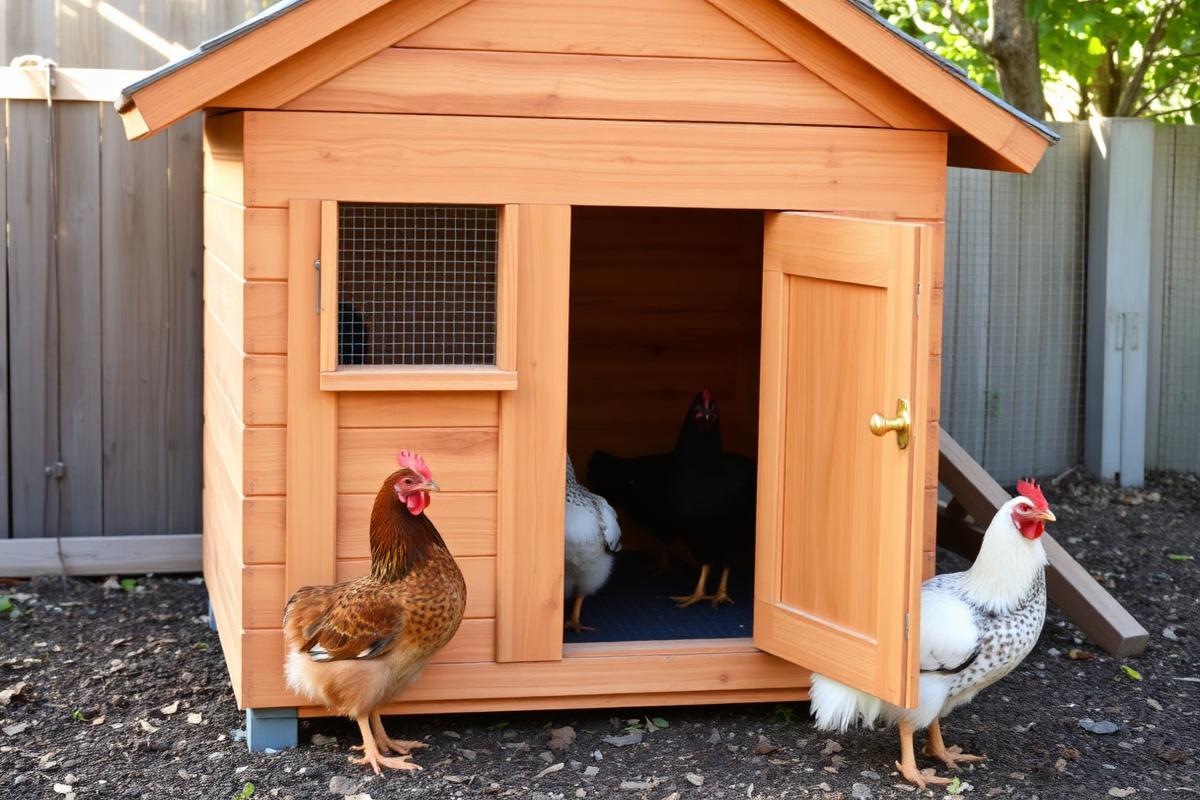
Four hens is the goldilocks number for backyard chicken keeping. It’s enough to give your family roughly a dozen fresh eggs per week during peak season—enough to feel like you’re actually getting something from the project. It’s small enough to fit comfortably in a 10x10 corner of most suburban yards without looking like you’re running a farm operation.
And here’s the thing most city ordinances don’t explicitly prohibit four chickens, whereas they do get nervous about twenty. You’ll spend about $200 to $500 building a proper home for four hens, and you’ll do it over a weekend with basic tools.
We’ve built coops for four hens, we’ve seen what works and what fails by mid-summer, and we’ve watched plenty of first-timers avoid the expensive mistakes. In this guide, we’re sharing five specific plans that we’d actually recommend to someone building their first coop. Each one includes footprints, material requirements, cost estimates, and what makes it work specifically for a flock of four. For the full collection of designs across all flock sizes, see our complete chicken coop plans guide.
Sized exactly for this flock: the 4×4 starter coop gives four hens the standard 4 square feet each, with a 4×4 screened run attached. Free preview PDF; the complete plan book is $4.99 on Etsy.
Starting those four birds as chicks? Size the brooder first with the chicken brooder size calculator before you build the coop they graduate into.
Table of Contents
- How Much Space Do 4 Chickens Actually Need?
- The 5 Best Chicken Coop Plans for 4 Chickens
- Materials and Costs
- Predator-Proofing for a Small Coop
- Common Mistakes When Building for 4 Hens
- Frequently Asked Questions
How Much Space Do 4 Chickens Actually Need?
This is the question we get wrong most often, and the question that matters most. If you want chickens that lay consistently, don’t peck each other bald, and don’t turn your coop into a disease incubator by July, you need to give them room.
Space Requirements for 4 Hens
Coop Interior
- Minimum: 16 sq ft (4x4)
- Sweet spot: 24 sq ft (4x6)
- Nesting boxes: 1–2 boxes (12x12”)
- Roosting bar: 32” minimum (8”/bird)
Outdoor Run
- Minimum: 40 sq ft (4x10)
- Comfortable: 80+ sq ft
- Ventilation: 2+ sq ft of vent area
- Access hatch: 2’x18” minimum
What happens if you undersize? Pecking. Feather loss. Stressed birds that are more susceptible to disease. A nasty spiral where the coop becomes a problem instead of an asset. For a detailed breakdown of your specific situation, check our chicken coop size calculator.
The 5 Best Chicken Coop Plans for 4 Chickens
1. The Classic 4x4 Walk-By Coop ($200–350)
Footprint: 4x4 coop + 4x8 run | Difficulty: Beginner | Build time: 6–8 hours
This is the design you see in every backyard chicken guide, and it’s popular because it actually works. A pitched-roof coop sitting on stilts, with an attached run. Four walls, two roof panels, and a floor. Stilts keep predators from digging under.
Materials: pressure-treated 4x4s for legs, 2x4 framing, T1-11 plywood siding or cedar, metal roofing, 1/4-inch hardware cloth, exterior wood screws, hinges, and a predator-proof latch.
Why it’s good for 4 hens: gives you the minimum space without being cramped, easily expandable, and simple enough that you won’t hate the building process. Learn more at 4x4 Chicken Coop Plans.
2. The A-Frame Starter Coop ($150–250)
Footprint: 4x8 | Difficulty: Absolute beginner | Build time: 4–5 hours
If you’re on a tight budget or you just want the simplest possible build, the A-frame wins. Only six major cuts needed. Takes up a 4x8 footprint, giving you 32 square feet. The A-frame is forgiving—if your angles aren’t perfect, it doesn’t matter much because gravity and the peaked shape hold everything together.
See our A-frame chicken coop plans for detailed build instructions.
3. The Tractor Coop for 4 Hens ($250–400)
Footprint: 4x6 | Difficulty: Intermediate | Build time: 8–10 hours
A “tractor” is a mobile coop with wheels or skids—you move it around your yard to give your hens fresh grass every day. Hens get bug hunting, grass, and whatever insects are in the soil. Your lawn gets a light scratch and some fertilizer. Everyone wins, except maybe the grubs.
See Mobile Chicken Coop Plans for the full guide.
4. The Urban Corner Coop ($300–500)
Footprint: 3x6 | Difficulty: Intermediate | Build time: 8–9 hours
City lot? HOA? Small backyard? This design prioritizes vertical space and a small footprint. It’s tall and narrow so it fits in the corner of a yard or against a fence without looking like you’ve built a barn. Roost area on top, nesting box area in the middle, and access/storage on the bottom.
See Urban Chicken Coop Plans for more.
5. The Converted Shed ($400–700)
Footprint: 4x6 to 6x8 | Difficulty: Intermediate | Build time: 4–6 hours of modification
This isn’t building from scratch—it’s taking a pre-built storage shed (usually $300–400) and converting it into a coop. You’re trading the romantic notion of “I built my coop” for speed, structural integrity, and the ability to upgrade to five or six hens later.
Materials and Costs
Here’s a general materials breakdown for a basic 4x4 coop for 4 hens:
ItemCost
Pressure-treated 4x4s (4)$35–50 2x4 framing lumber (8–10)$40–60 T1-11 plywood siding (2 sheets)$50–80 1/2” hardware cloth (50 sq ft)$30–50 Metal roofing or shingles$30–50 Exterior screws (5-lb box)$20–30 Door hinges and predator-proof latches$30–45 Stain/paint (optional)$20–30
Total: $250–350, depending on material quality. For a detailed breakdown, see our Coop Materials Guide and chicken coop plans with materials list.
Predator-Proofing for a Small Coop
Four hens are precious enough to warrant real predator protection. Here’s what actually works.
- Hardware cloth, not chicken wire. Chicken wire keeps chickens in. It does not keep predators out. Raccoons tear through it like paper. Use 1/2-inch hardware cloth.
- Buried apron. Dig a trench 12 inches wide around the base. Bury the bottom 6 inches of hardware cloth and extend 6 inches out at ground level.
- Two-step door latch. Raccoons literally have hands. Use a sliding bolt with a pin through it, or a drop-down wooden latch that requires two steps to open.
- Close the coop at dusk. Every single day, no exceptions. Use an automatic pop-door if you can afford it ($100–200).
More details at Predator-Proof Coop Guide.
Common Mistakes When Building for 4 Hens
- Undersizing because “we’ll never get more than 4 hens.” You will. Build for six. Use four today, upgrade later.
- Using chicken wire instead of hardware cloth. This is the #1 regret we hear. Do it right the first time.
- Skipping ventilation. Chickens are tougher than you think, and ammonia is worse than cold. Ventilation wins.
- Placing the coop in direct afternoon sun. Summer heat kills hens faster than almost anything else. Pick shade.
- Cheap latches and door hinges. Hardware is cheap. Replacing dead hens because a latch failed is expensive and heartbreaking.
- No cleanout access. Build an access hatch or door you can actually crawl through or reach into.
- Forgetting about the run. The coop is where they sleep. The run is where they live. Run size matters as much as coop size.
See our expensive coop mistakes guide for more costly pitfalls to avoid.
Pick Your Plan and Get Building
If you’re building your first coop, start with the Classic 4x4. The A-frame is perfect on a budget. The tractor works if you have the space. The urban coop is your answer in a tight spot. Whatever you pick, give your four hens the space they deserve, predator-proof it properly, and close the door at night.
Start with our chicken coop size calculator, or browse our full collection of chicken coop plans.