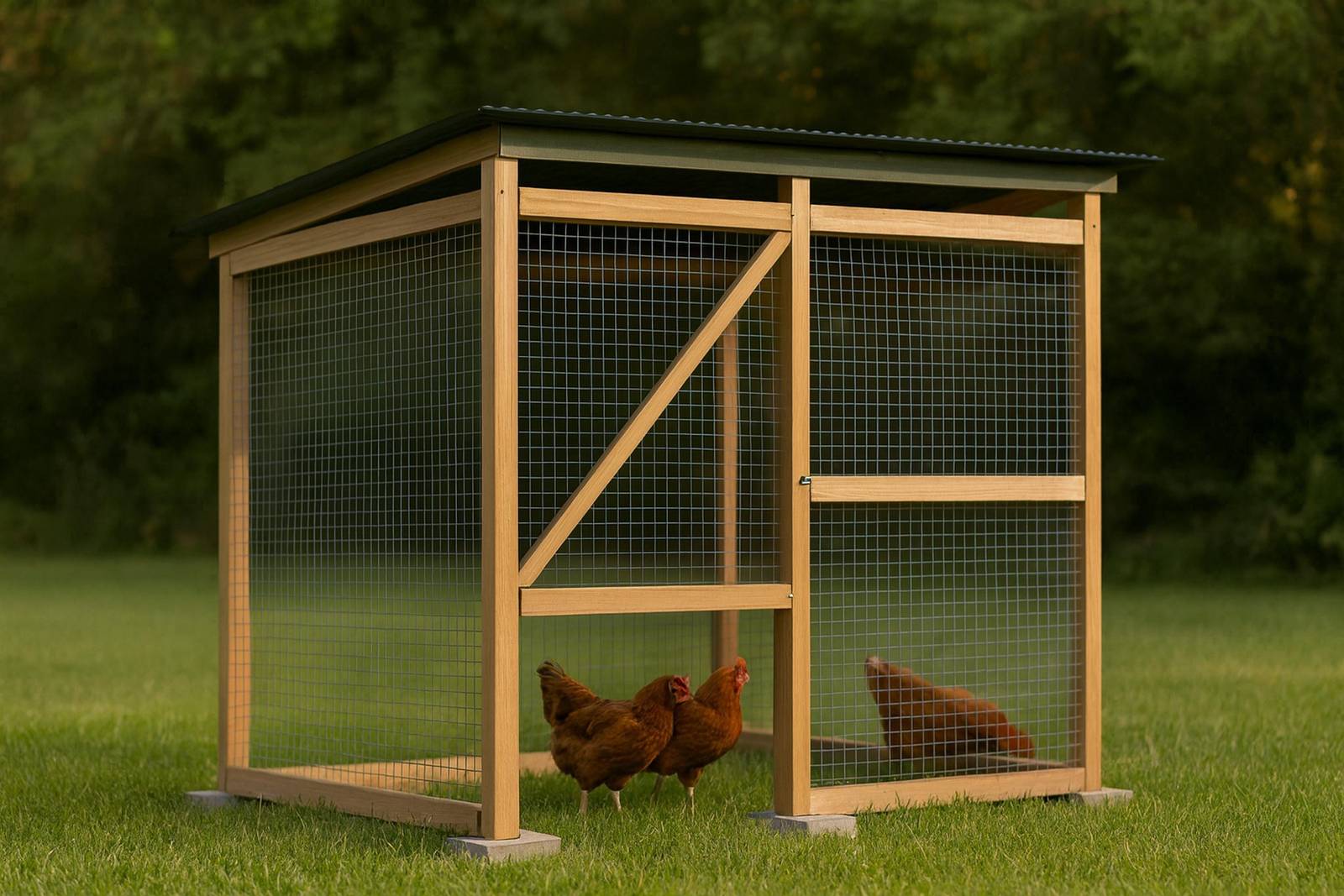
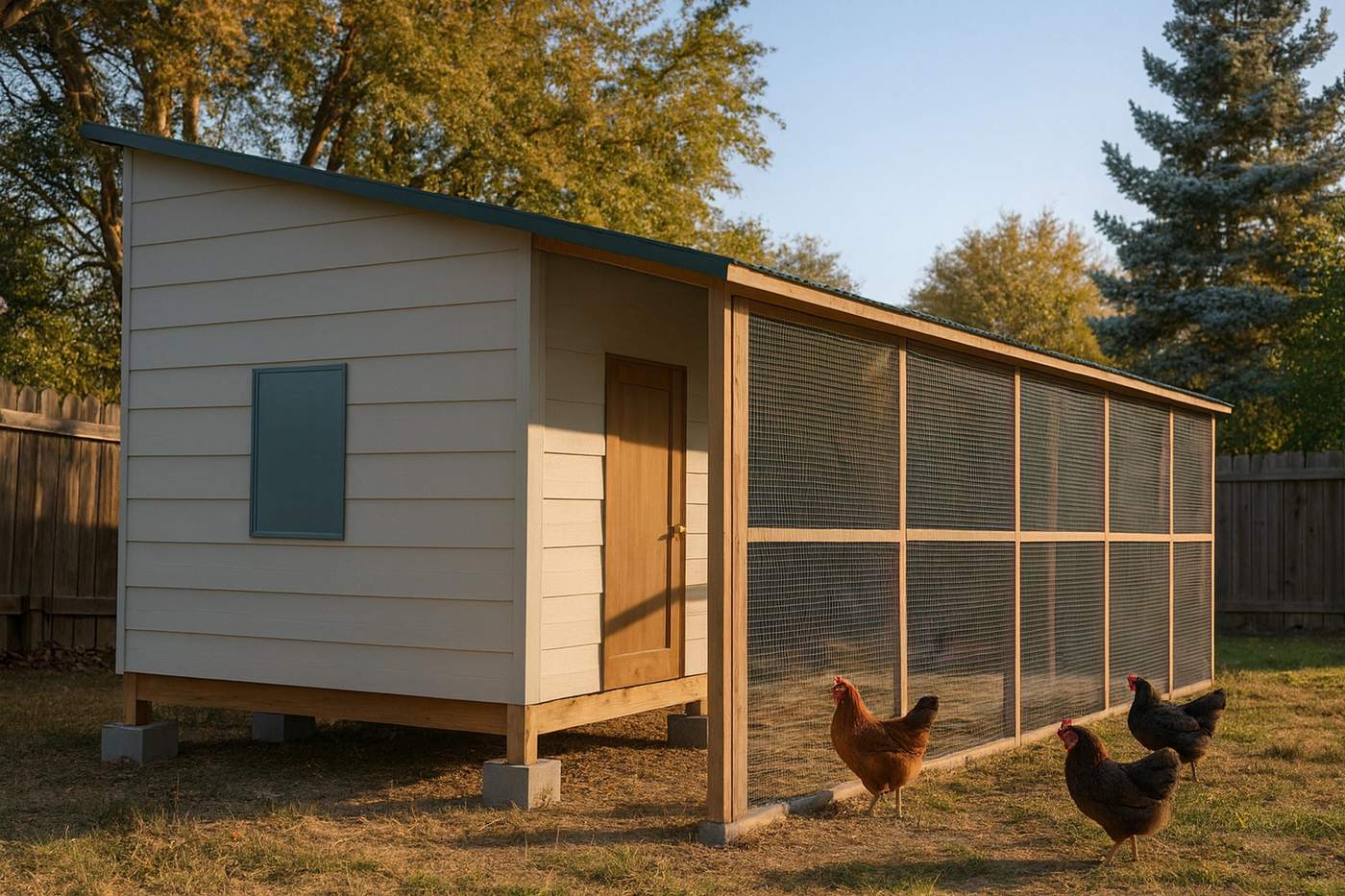
We have three standalone, walk-in chicken run plans with free cut lists: the 6x8 for 6 to 9 hens ($850 to $1,100), the 8x16 for 16 to 25 ($1,300 to $1,700) and the 10x20 for 25 to 40 ($1,900 to $2,450). Every one is sized so the comfortable flock gets 8 sq ft a bird, which matches Penn State’s figure for laying hens.
These are runs without a coop: no floor, no nests, no roost. You bolt them to a coop you own or build the run first and the coop later. Each is its own frame on buried posts, and each is roofed in hardware cloth, so a raccoon that climbs a post gets nothing at the top.
The three runs
| Plan | Run area | Comfortable / ceiling hens | Sq ft per hen at each | Materials | Build | Level | Shade cloth |
|---|---|---|---|---|---|---|---|
| 6x8 run | 48 sq ft | 6 / 9 | 8.0 / 5.3 | $850-$1,100 | 10-14 hrs | Beginner | 16 sq ft (33%) |
| 8x16 run | 128 sq ft | 16 / 25 | 8.0 / 5.1 | $1,300-$1,700 | 22-30 hrs | Intermediate | 43 sq ft (34%) |
| 10x20 run | 200 sq ft | 25 / 40 | 8.0 / 5.0 | $1,900-$2,450 | 30-40 hrs | Intermediate | 67 sq ft (34%) |
The ceiling number is a space number, not a welfare number. At the top of each rating a hen has between 5 and 5.3 sq ft, which works if the flock ranges and sleeps in the run only in bad weather. Penn State lists 8 sq ft for laying hens and 10 for large chickens, and poultry.extension.org says 10, so size to the comfortable column if the birds live in the pen. The run size calculator works the arithmetic for a mixed flock.
What the frame does
The posts are 4x4s, 96 inches long with 24 buried, ground-contact rated, set in gravel like fence posts: 8 on the 6x8, 12 on the 8x16 and 18 on the 10x20, plus the shorter centre posts under its beam. Rails sit with their tops at 32, 64 and 72 inches above grade, which is not arbitrary. Hardware cloth comes off a 36-inch roll, so a course starting at one rail has to reach the next with a 4-inch lap. The 10x20 adds a centre beam of doubled 2x6 because a 120-inch purlin span is more than the plan will ask a 2x4 to carry.
Head height is the honest number here. The post tops are 72 inches above grade, and inside the run it is 72 inches from grade to the underside of a purlin, less the 3 to 4 inches of sand on the floor. Through the gate it is 67 inches, threshold to header, and the plan says tall people duck. A tall builder should expect to duck at the gate and weigh that before choosing a run you will rake out every week.
Hardware cloth, apron and the gate
All three specify 1/4-inch, 19-gauge cloth, screwed through 1-inch fender washers along every rail and post, lapped 4 inches onto cloth and ringed every 6. The cloth goes on the outside of the frame so a predator pushes it against the wood rather than off it. The apron is an L, 12 inches down and 12 out, buried, and it runs under the gate threshold too. Kentucky says to bury hardware cloth at least 12 inches; Penn State says 12 and toe it out about 6. The surface-skirt method some people pin flat to the ground is not what we draw, so the L is dug in.
| Plan | Walls | Roof | Buried apron | Gate | Needed | Bought in rolls | Left over | Apron alone | Rolls bought at $3.10 a foot (share of low-end cost) |
|---|---|---|---|---|---|---|---|---|---|
| 6x8 run | 63 | 18 | 19 | 8 | 108 | 125 | 17 | $59 | $388 (46%) |
| 8x16 run | 108 | 48 | 32 | 8 | 196 | 200 | 4 | $99 | $620 (48%) |
| 10x20 run | 135 | 75 | 40 | 8 | 258 | 275 | 17 | $124 | $852 (45%) |
Footage is in running feet of the 36-inch roll, and the rolls come in 25, 50 and 100 foot lengths, so you carry some offcut. The apron is the cheapest insurance on the page: $59 on the 6x8, $99 on the 8x16, $124 on the 10x20 at the generator’s $3.10 a foot. The rolls you buy come to 45 to 48 percent of the run’s low-end cost. See the hardware cloth guide for the rest of the footage math.
The gate fills a whole 42-3/4 to 43-13/16 inch post bay, so there is no jamb and no infill panel. It has three hinges, a two-action latch and a barrel bolt dropping into the threshold, because the bolt keeps the bottom corner from being levered out.
Roofed or netted, and attaching to a coop
Kentucky suggests orange netting for persistent aerial predators, kept tight because hawks find loose spots, and Penn State says to cover runs with mesh or netting. Our plans use cloth for the roof, with shade cloth over a third of it, about 16, 43 and 67 sq ft. Netting answers a hawk and does not answer a raccoon that climbs the post.
To attach a run to an existing coop, cut a pop door through the coop wall and land it inside the run perimeter. The run does not lean on the coop for support. If you are still choosing a coop, the 8x12 walk-in has a 128 sq ft run, the same area as the 8x16 run, built in. The run design guide covers layout, and mud control starts with the sand and the grade.