You don’t need carpentry experience to build a professional chicken coop. After teaching 20+ first-time builders across Phoenix neighborhoods—including complete novices who had never used a circular saw—I’ve identified the exact approach that transforms intimidated beginners into confident coop builders in a single weekend.
The secret isn’t simplified construction—it’s simplified instruction. Quality beginner plans break complex projects into manageable steps, anticipate common mistakes, and provide the detailed guidance that experienced builders take for granted. This comprehensive guide reveals exactly what makes chicken coop plans truly beginner-friendly and how to choose designs that guarantee first-time success.
Beginner Skill Assessment Tool
Check the skills you’re comfortable with to see if you’re ready to build:
className=“sr-only” />
))}
= 6 ? ‘bg-green-50 border border-green-200’ : skillCount >= 4 ? ‘bg-yellow-50 border border-yellow-200’ : skillCount >= 2 ? ‘bg-orange-50 border border-orange-200’ : ‘bg-red-50 border border-red-200’ }`}>
/6 Skills —
What Makes Plans Truly Beginner-Friendly
Beginner-friendly plans anticipate inexperience rather than assuming knowledge. The difference between intimidating plans and confidence-building plans isn’t project complexity—it’s instructional detail and mistake prevention.
Visual Learning Support
- Step-by-step photographs: Every cut, every assembly stage, every connection method
- Multiple angle views: Show what components look like from builder’s perspective
- Before/during/after photos: Clear progression through each stage
- Common mistake photos: “This is wrong” examples with corrections
Our complete building guide includes step-by-step photo guides for every cut, eliminating the guesswork that stops most first-time projects.
Detailed Instruction Approach
- Assumed knowledge = zero: Plans explain why each step matters
- Tool usage guidance: How to use tools safely and effectively
- Measurement verification: “Measure twice, cut once” with specific check methods
- Assembly sequence logic: Why this order prevents problems later
Mistake Prevention Systems
- Warning callouts: “STOP: Check this before proceeding”
- Common error alerts: “Most beginners do this wrong…”
- Quality checkpoints: Verification steps at critical stages
- Recovery procedures: How to fix mistakes without starting over
Honest Skill Level Requirements
Successful beginner projects require basic comfort with tools, not carpentry expertise. If you can measure accurately, cut straight lines, and drill holes, you can build a quality chicken coop.
Skills You Need
- • Reading a tape measure (understanding fractions)
- • Using a level to check flat and vertical
- • Basic drilling (pilot holes and driving screws)
- • Safe cutting with circular or miter saw
Skills You DON’T Need
- • Complex joinery or woodworking techniques
- • Experience with framing or construction
- • Electrical or plumbing knowledge
- • Advanced tool operation
Learning curve expectations: Most tool skills develop during the first few cuts. Quality beginner plans include practice recommendations—make your first cuts on scrap lumber to build confidence before cutting actual project pieces.
Physical Requirements
- • Lift 25-30 pounds (a single 2×4×8 board)
- • Work comfortably while kneeling or bending
- • Handle power tools with steady hands
- • Spend 4-6 hours on feet over a weekend
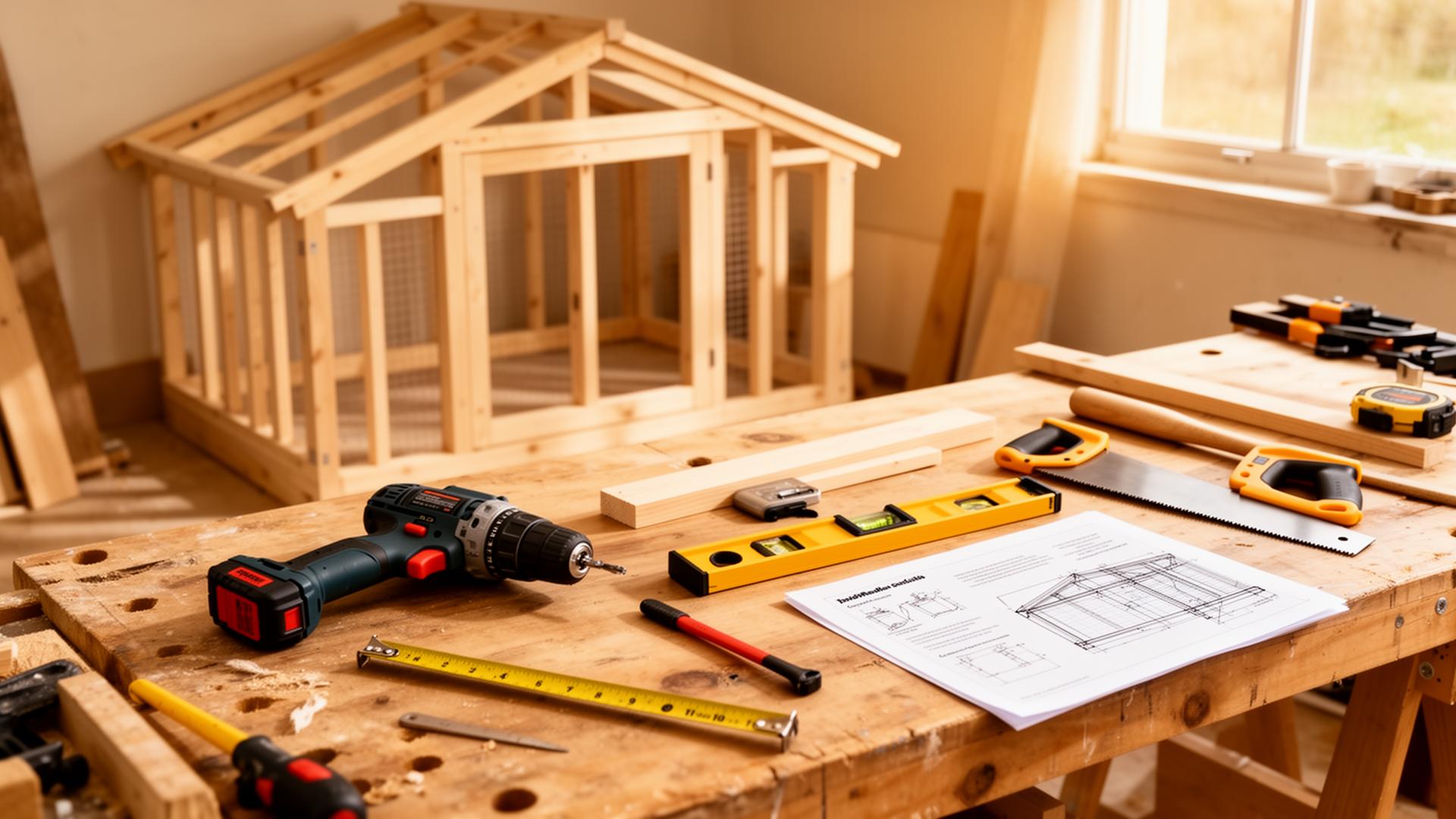
Basic Tool Requirements (You Probably Own These)
Most beginner-friendly coop builds require only 6-8 basic tools. If you own a toolbox for household repairs, you likely have 80% of what’s needed. Our materials guide includes clear alternatives for any specialized equipment.
Essential Tools (Must Have)
- Tape measure: 25-foot minimum for measuring lumber
- Level: 2-foot or 4-foot for checking alignment
- Drill/driver: Cordless drill with bits and attachments
- Circular saw OR miter saw: For cutting lumber
- Square: Speed square or framing square for marking
- Safety gear: Safety glasses and hearing protection
Helpful Tools (Nice to Have)
- Clamps: Hold pieces while drilling (4-6 clamps ideal)
- Socket set: For lag bolts and heavy-duty connections
- Hammer: For adjustments and nail-in hardware
- Utility knife: Cutting hardware cloth and materials
Tool Rental Options
Don’t own a circular saw? Most home improvement stores rent quality tools for $40-60/day. Many beginners find miter saws easier to use than circular saws for accurate crosscuts.
Budget Tool Recommendations
- Cordless drill: Ryobi ONE+ ($79-99 with battery)
- Circular saw: Ryobi 7-1/4” ($89-109)
- Speed square: Swanson 7” ($15-20)
- Level: Empire 24” ($25-35)
Best Coop Sizes for First-Time Builders
Start with designs sized for 4-6 chickens. These provide meaningful egg production while keeping projects manageable for beginners. Larger coops introduce complexity that can overwhelm first-time builders.
4×6 Coops (4-5 chickens) — Recommended
- Why it works: Uses standard 8-foot lumber with minimal cutting
- Manageable size: Components are light enough for one person
- Reasonable cost: $400-600 in materials
- Weekend project: Buildable in 2-3 days for beginners
4×8 Coops (6-7 chickens)
- Popular choice: Good balance of flock size and build complexity
- Standard materials: Efficient use of 4×8 plywood sheets
- Room for mistakes: Larger size forgives minor measurement errors
- Growth accommodation: Can handle flock expansion
Use our size calculator to determine the right coop dimensions for your planned flock size.
Avoid as First Projects
- Coops under 4×4: Too cramped, require precision cuts
- Coops over 6×10: Heavy components, complex assembly
- Multi-level designs: Increase complexity significantly
- Custom shapes: Hexagonal, round, or angular designs
The Step-by-Step Building Process
Quality beginner plans break construction into logical phases that build skills progressively. Each phase teaches techniques used in subsequent stages, creating confidence through manageable accomplishments.
Browse our small coop plans designed specifically for first-time builders—plans that follow this progressive skill-building approach.
10 Most Common Beginner Mistakes (And How to Avoid Them)
Every beginner makes predictable mistakes. Quality plans anticipate these errors and provide specific prevention strategies. Learn more about costly mistakes to avoid.
Beginner-Friendly Material Choices
Choose materials that forgive mistakes and are easy to work with. Premium materials can wait until you’ve built confidence with basic projects. See our complete materials guide for detailed specifications.
Pressure-Treated Lumber (Foundation)
- Why: Ground contact resistance, longer lifespan
- Use for: Skids, floor frames, bottom plates
- Beginner tip: Slightly more expensive but prevents early failures
Standard Pine/Fir (Framing)
- Why: Easy to cut, readily available, cost-effective
- Use for: Wall studs, roof rafters, trim
- Beginner tip: Choose straight pieces—warped lumber creates problems
Plywood (Sheathing)
- OSB alternative: Cheaper but less forgiving of moisture
- Thickness: 1/2” for walls, 5/8” for floors
- Beginner tip: Mark cut lines clearly—plywood splinters easily
Hardware Cloth Specifications
- Size: 1/2-inch aperture, 19-gauge galvanized
- Why not chicken wire: Provides no predator protection
- Beginner tip: Buy 10% extra—first-time installation includes mistakes
Fastener Simplification
- Galvanized screws: 2.5” for framing, 1.5” for sheathing
- Avoid nails: Screws are more forgiving for beginners
- Hardware cloth: Screws with washers, not staples
Realistic Time Expectations
Beginner projects take 2-3 times longer than experienced builder estimates. Plan accordingly and don’t schedule tight deadlines that create stress and mistakes.
Realistic Beginner Timeline (4×6 Coop)
Preparation Day
-
• Site prep: 2-3 hours (leveling, organizing materials)
-
• Plan review: 1 hour (understanding each step)
-
• Tool setup: 30 minutes (organizing work area)
Construction Day 1
-
• Foundation: 2-3 hours (measuring, cutting, assembly)
-
• Floor frame: 2-3 hours (first major component)
-
• Learning curve: Extra time for developing tool skills
Construction Day 2
-
• Wall framing: 4-5 hours (more complex than floor)
-
• Wall assembly: 2-3 hours (connecting components)
-
• Roof framing: 2-3 hours (if energy remains)
Construction Day 3
-
• Roof completion: 2-3 hours (sheathing, roofing)
-
• Finishing: 3-4 hours (siding, hardware cloth, doors)
-
• Final touches: 1-2 hours (interior fittings)
See our cost breakdown guide for accurate budget planning alongside your timeline.
When to Ask for Help (And Who to Ask)
Knowing when to ask for help prevents costly mistakes and dangerous situations. Even experienced builders consult others for specialized tasks.
When to Get Help
- • Heavy lifting (raising walls, placing roof panels)
- • Any electrical work (lighting, outlets)
- • Cutting on ladders or elevated surfaces
- • When measurements consistently don’t match
- • Before making cuts you’re unsure about
Who to Ask
- Local hardware store staff: Tool selection, material advice
- YouTube tutorials: Specific technique demonstrations
- Experienced friends/family: Extra hands and knowledge
- Online communities: Troubleshooting specific problems
- Local chicken groups: Coop-specific advice
Building Confidence Through Small Wins
Confidence grows through successful completion of progressively complex tasks. Quality beginner plans build skills systematically rather than throwing you into difficult work immediately.
Confidence-Building Sequence
- 1 Practice cuts on scrap: Get comfortable with your saw before cutting project pieces
- 2 Build the floor first: Simplest component, develops core skills
- 3 Assemble walls flat: Easier than building vertically
- 4 Raise walls with help: Team effort for the exciting part
- 5 Finish with visible details: Trim and doors show your accomplishment
Recommended Beginner Plans
Not all “beginner” plans are truly beginner-friendly. Look for plans that include all the elements discussed in this guide. Use our quality checklist to evaluate any plan before starting.
Best for True Beginners
- • Small chicken coop plans (4-6 birds)
- • 4×4 coop plans (smallest manageable size)
- • Simple shed-style roof designs
- • Ground-level builds (no elevation)
After Your First Build
- • Large coop plans (bigger flock)
- • Mobile coop designs (chicken tractors)
- • Elevated coops with storage underneath
- • Multi-section designs with separate areas
Ready to Start?
Browse our collection of recommended plans vetted for beginner-friendliness, or check out our free plan resources to get started without investment.
Your First Coop: Start Simple, Build Confidence
Building a chicken coop as a beginner is absolutely achievable. Success comes from choosing appropriately sized projects, using quality plans with detailed instructions, and accepting that learning takes time.
Your first coop doesn’t need to be perfect—it needs to be safe, functional, and completed. The skills you develop building a simple 4×6 coop will serve you for every future project.
Start with manageable goals, celebrate small wins, and remember: every experienced builder started exactly where you are now.
Frequently Asked Questions
Can I really build a coop with no experience?
Yes—if you choose appropriate plans. Start with a simple 4×6 design using basic tools. Most beginners successfully complete their first coop in 2-3 weekends with zero prior building experience.
What’s the easiest coop design for beginners?
Ground-level coops with simple shed-style (single-slope) roofs are easiest. Avoid elevated designs, gable roofs, or coops with multiple sections for your first build. A 4×6 or 4×8 rectangle provides the best balance of simplicity and function.
How long will my first coop take to build?
Plan for 3-4 full days of work over 2 weekends for a simple 4×6 coop. Experienced builders might complete the same project in 1-2 days, but beginners need extra time for learning, measuring, and correcting mistakes.
What if I make mistakes during construction?
Most mistakes are fixable. Cut a board too short? Use it elsewhere or buy a replacement (lumber is cheap). Drilled a hole in the wrong place? Fill it with wood filler. Screwed something crooked? Unscrew and try again. Quality plans include recovery procedures for common errors.
Should I buy tools or rent them?
Buy a cordless drill and basic measuring tools—you’ll use these for many projects. Rent specialized tools like miter saws if you’re unsure about future projects. A full basic tool set costs $200-300 and pays for itself after 2-3 projects.